<?xml version="1.0" encoding="utf-8"?><feed xmlns="http://www.w3.org/2005/Atom" xml:lang="en"><generator uri="https://jekyllrb.com/" version="4.4.1">Jekyll</generator><link href="https://hungrybear.digital/feed.xml" rel="self" type="application/atom+xml" /><link href="https://hungrybear.digital/" rel="alternate" type="text/html" hreflang="en" /><updated>2026-09-12T14:37:25+00:00</updated><id>https://hungrybear.digital/feed.xml</id><title type="html">Hungry Bear</title><subtitle>Proactive Meta, Google and TikTok ads management for trade schools, academies and skills training programs.</subtitle><author><name>Benjamin Boman</name></author><entry><title type="html">What I’d Do First If My Local Facebook Lead Gen Ads Weren’t Working</title><link href="https://hungrybear.digital/facebook-lead-ads-not-working" rel="alternate" type="text/html" title="What I’d Do First If My Local Facebook Lead Gen Ads Weren’t Working" /><published>2026-05-27T21:53:50+00:00</published><updated>2026-05-27T21:53:50+00:00</updated><id>https://hungrybear.digital/facebook-lead-ads-not-working</id><content type="html" xml:base="https://hungrybear.digital/facebook-lead-ads-not-working"><![CDATA[<p><button type="button" class="video" data-youtube="qtm2EFP-JwA" aria-label="Play video: What I&#39;d Do First If My Local Facebook Lead Gen Ads Weren&#39;t Working">
  <img src="/assets/images/youtube/qtm2EFP-JwA.webp" alt="" width="1280" height="720" loading="lazy" />
  <span class="video__play"></span>
</button></p>

<p>﻿</p>

<p>If your local lead gen ads on Meta aren’t producing, it usually comes down to one of five things - and they’re not actually technical problems. They’re strategic issues. In this video I walk through each of them and how to fix them.</p>]]></content><author><name>Benjamin Boman</name></author><summary type="html"><![CDATA[If your local lead gen ads on Meta aren't producing, it usually]]></summary><media:thumbnail xmlns:media="http://search.yahoo.com/mrss/" url="https://hungrybear.digital/assets/images/youtube/qtm2EFP-JwA.webp" /><media:content medium="image" url="https://hungrybear.digital/assets/images/youtube/qtm2EFP-JwA.webp" xmlns:media="http://search.yahoo.com/mrss/" /></entry><entry><title type="html">How to Fix Trash Form Leads on Facebook Ads in 2026</title><link href="https://hungrybear.digital/bad-leads-from-facebook-ads" rel="alternate" type="text/html" title="How to Fix Trash Form Leads on Facebook Ads in 2026" /><published>2026-04-29T21:55:59+00:00</published><updated>2026-04-29T21:55:59+00:00</updated><id>https://hungrybear.digital/bad-leads-from-facebook-ads</id><content type="html" xml:base="https://hungrybear.digital/bad-leads-from-facebook-ads"><![CDATA[<p><button type="button" class="video" data-youtube="a3X3Tv7Cnx8" aria-label="Play video:  How to Fix Trash Form Leads on Facebook Ads in 2026">
  <img src="/assets/images/youtube/a3X3Tv7Cnx8.webp" alt="" width="1280" height="720" loading="lazy" />
  <span class="video__play"></span>
</button></p>

<p>Before you write off Meta lead forms as a source of bad leads, it’s worth checking if you’re actually using them properly. I go through seven features in this video that most local advertisers miss - because the form itself usually isn’t the problem, it’s how it’s been set up and what’s been left switched off (or on!).</p>]]></content><author><name>Benjamin Boman</name></author><summary type="html"><![CDATA[Before you write off Meta lead forms as a source of bad leads, it's worth checking if you're actually using them properly. I go through seven features in…]]></summary><media:thumbnail xmlns:media="http://search.yahoo.com/mrss/" url="https://hungrybear.digital/assets/images/youtube/a3X3Tv7Cnx8.webp" /><media:content medium="image" url="https://hungrybear.digital/assets/images/youtube/a3X3Tv7Cnx8.webp" xmlns:media="http://search.yahoo.com/mrss/" /></entry><entry><title type="html">How to Analyze Facebook Ads (Even with Low Conversions) - Full Tutorial</title><link href="https://hungrybear.digital/analyze-facebook-ads-results" rel="alternate" type="text/html" title="How to Analyze Facebook Ads (Even with Low Conversions) - Full Tutorial" /><published>2025-12-17T22:19:58+00:00</published><updated>2025-12-17T22:19:58+00:00</updated><id>https://hungrybear.digital/analyze-facebook-ads-results</id><content type="html" xml:base="https://hungrybear.digital/analyze-facebook-ads-results"><![CDATA[<p><button type="button" class="video" data-youtube="cmxeMY5xMBw" aria-label="Play video:  How to Analyze Facebook Ads (Even with Low Conversions) - Full Tutorial">
  <img src="/assets/images/youtube/cmxeMY5xMBw.webp" alt="" width="1280" height="720" loading="lazy" />
  <span class="video__play"></span>
</button></p>

<p>Understanding your marketing metrics sounds boring but it can be really interesting for discovering performance leaks in your overall funnel.</p>

<p>In this video you’ll learn how to understand facebook ads metrics, and how I use them in practice to diagnose issues and find insights for scaling.</p>]]></content><author><name>Benjamin Boman</name></author><summary type="html"><![CDATA[Understanding your marketing metrics sounds boring but it can be really interesting for discovering performance leaks in your overall funnel. In this video…]]></summary><media:thumbnail xmlns:media="http://search.yahoo.com/mrss/" url="https://hungrybear.digital/assets/images/youtube/cmxeMY5xMBw.webp" /><media:content medium="image" url="https://hungrybear.digital/assets/images/youtube/cmxeMY5xMBw.webp" xmlns:media="http://search.yahoo.com/mrss/" /></entry><entry><title type="html">5 Ways I Reduce Cost Per Lead (CPL) on Facebook Ads</title><link href="https://hungrybear.digital/reduce-cost-per-lead-facebook-ads" rel="alternate" type="text/html" title="5 Ways I Reduce Cost Per Lead (CPL) on Facebook Ads" /><published>2025-12-08T22:18:01+00:00</published><updated>2025-12-08T22:18:01+00:00</updated><id>https://hungrybear.digital/reduce-cost-per-lead-facebook-ads</id><content type="html" xml:base="https://hungrybear.digital/reduce-cost-per-lead-facebook-ads"><![CDATA[<p><button type="button" class="video" data-youtube="oaUMvnjMh8o" aria-label="Play video: 5 Ways I Reduce Cost Per Lead (CPL) on Facebook Ads">
  <img src="/assets/images/youtube/oaUMvnjMh8o.webp" alt="" width="1280" height="720" loading="lazy" />
  <span class="video__play"></span>
</button></p>

<p>Are you investing heavily in lead generation ads but worried about the quality of leads? Discover five effective strategies to reduce your cost per lead without compromising on quality (too much).</p>]]></content><author><name>Benjamin Boman</name></author><summary type="html"><![CDATA[Are you investing heavily in lead generation ads but worried about the quality of leads? Discover five effective strategies to reduce your cost per lead…]]></summary><media:thumbnail xmlns:media="http://search.yahoo.com/mrss/" url="https://hungrybear.digital/assets/images/youtube/oaUMvnjMh8o.webp" /><media:content medium="image" url="https://hungrybear.digital/assets/images/youtube/oaUMvnjMh8o.webp" xmlns:media="http://search.yahoo.com/mrss/" /></entry><entry><title type="html">A simple explanation of the The Meta Business Suite</title><link href="https://hungrybear.digital/meta-business-suite-explained" rel="alternate" type="text/html" title="A simple explanation of the The Meta Business Suite" /><published>2025-11-03T03:12:35+00:00</published><updated>2025-11-03T03:12:35+00:00</updated><id>https://hungrybear.digital/meta-business-suite-explained</id><content type="html" xml:base="https://hungrybear.digital/meta-business-suite-explained"><![CDATA[<p>Most people find this really confusing to work with and navigate so here is a quick guide to the Meta ecosystem from an advertising point of view.</p>

<h2 id="quick-overview">Quick Overview</h2>

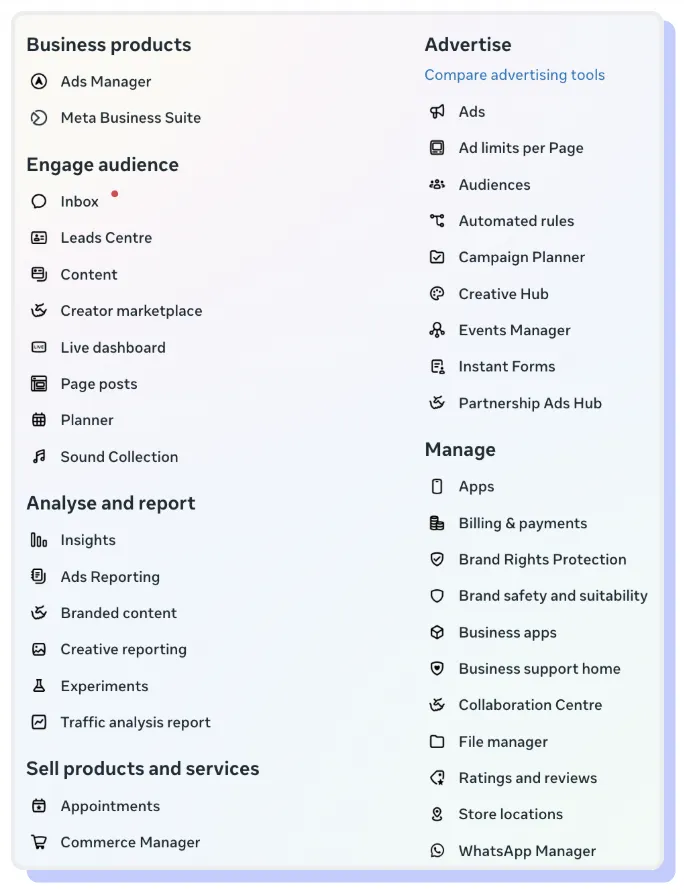
<p><strong>What is the Meta Business Suite?</strong> It’s essentially Meta’s set of tools that you use to run ads or promote your business on Facebook and Instagram.</p>

<p><img src="/assets/images/blog/meta-business-suite-explained/01.webp" alt="" /></p>

<p>It includes tools like:</p>

<ul>
  <li>Ads Manager</li>
  <li>Creative Hub (for pre-building ads)</li>
  <li>Events Manager (for managing pixels/datasets)</li>
  <li>etc</li>
</ul>

<p>There are dozens of tools in the suite, and they each change all the time, including what they’re called.</p>

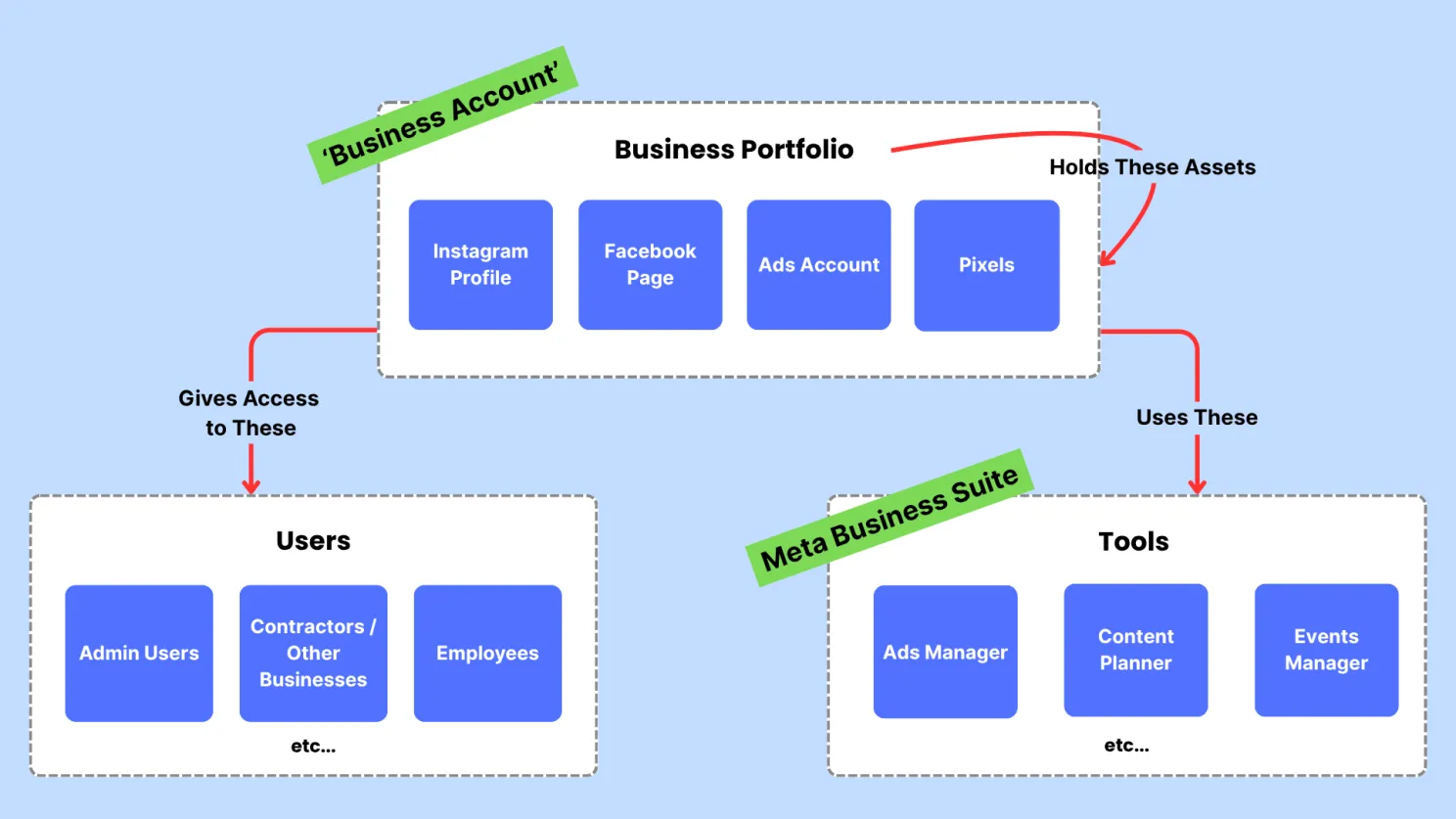
<p>But it is just one part of the overall ecosystem, which includes a few key parts:Here’s what each of them are:</p>

<p><img src="/assets/images/blog/meta-business-suite-explained/02.webp" alt="" /></p>

<ul>
  <li><strong>Users</strong> which are the individual Facebook <em>personal user accounts</em>. You, me, whoever. They are required to use the Meta Business Suite.</li>
</ul>

<p>Note: do not create a fake or catchall brand account and share. one this leads to constant battles over 2FA and logging in, but also can get the account banned or flagged (link).</p>

<ul>
  <li><strong>Assets</strong> are your Facebook pages, Instagram profiles, advertising datasets (aka pixels), catalogues and other data sources etc.</li>
</ul>

<p>All assets are created by individuals before they’re added to a Business Portfolio, which is…</p>

<ul>
  <li><strong>Business Portfolio,</strong> which is like a business account on Facebook. It’s an entity that can own and control your business assets, rather than an individual.</li>
</ul>

<p>Once you have a Business Portfolio set up correctly, you can grant access to multiple people including employees, contractors, other admins, with different levels of control.</p>

<ul>
  <li><strong>Partners</strong> are other Business Portfolios, usually agencies, that you can share access to your Business Portfolio as if you were sharing access to another person.</li>
</ul>

<p>Because they are their own Business Portfolio, they can grant access of different levels to your assets to their team members without you adding and removing them individually.</p>

<ul>
  <li><strong>Tools.</strong> These are things like the Ads Manager, Events Manager, Scheduler, etc that help you use or manage the assets in your Business Portfolio.</li>
</ul>

<p>You can grant individual users access to different levels of control of these tools based on their permissions on an asset level.</p>

<hr />

<h2 id="how-to-navigate-to-your-business-portfolio">How to navigate to your Business Portfolio</h2>

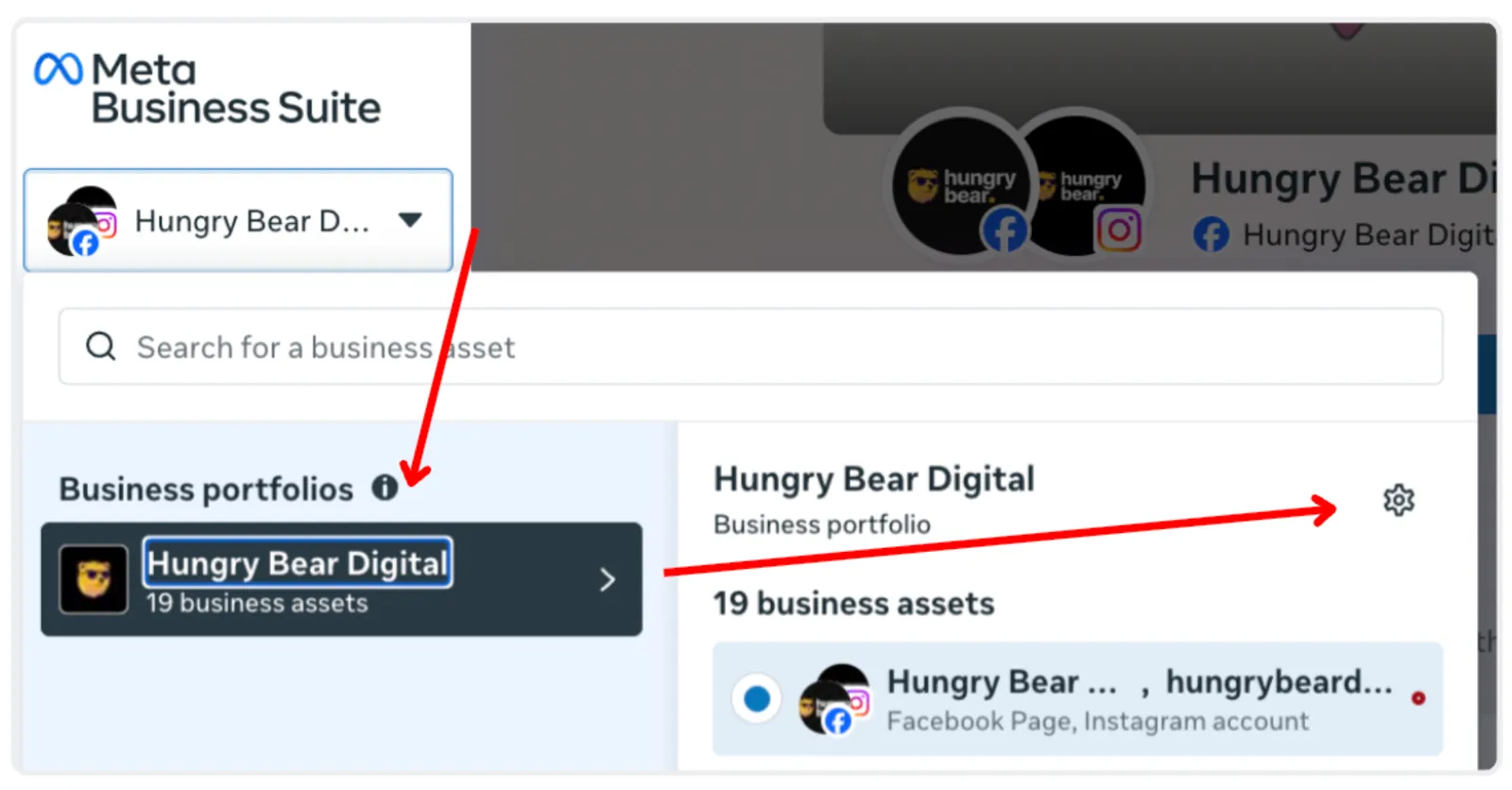
<p>So, usually you will want to control the settings of your business portfolio, or get to an individual tool / asset.</p>

<p>To navigate to your portfolio for the first time, go to here <a href="https://business.facebook.com/"><strong>https://business.facebook.com/</strong></a> and click the menu in the top left corner. Then click your portfolio.</p>

<p><img src="/assets/images/blog/meta-business-suite-explained/04.webp" alt="" /></p>

<p>If you’re already using a tool of the Meta Business Suite already, you can always click the same menu in the top left, and then the gear icon to navigate back to your portfolio to edit its settings (like adding a new asset such as a page, profile or pixel.</p>

<hr />

<h2 id="faq">FAQ</h2>

<h3 id="q-can-i-create-a-facebook-ads-account-without-a-facebook-account">Q. Can I create a Facebook Ads account without a Facebook account?</h3>

<p>A. Sadly, no. Everyone needs a personal Facebook user account to use the Meta Business Suite.</p>

<h3 id="q-how-to-get-setup-on-meta-business-suite">Q. How to get Setup on Meta Business Suite?</h3>

<p>A. You need to create your business assets first with your personal profiles, then create Business Portfolio, then add your assets to it.</p>]]></content><author><name>Benjamin Boman</name></author><summary type="html"><![CDATA[Most people find this really confusing to work with and navigate so here is a quick guide to the Meta ecosystem from an advertising point of view.]]></summary><media:thumbnail xmlns:media="http://search.yahoo.com/mrss/" url="https://hungrybear.digital/assets/images/blog/meta-business-suite-explained/01.webp" /><media:content medium="image" url="https://hungrybear.digital/assets/images/blog/meta-business-suite-explained/01.webp" xmlns:media="http://search.yahoo.com/mrss/" /></entry><entry><title type="html">The Right Way to Setup Facebook Ads for Your Newsletter (Beginner-Friendly)</title><link href="https://hungrybear.digital/facebook-ads-for-newsletters" rel="alternate" type="text/html" title="The Right Way to Setup Facebook Ads for Your Newsletter (Beginner-Friendly)" /><published>2025-10-09T22:23:36+00:00</published><updated>2025-10-09T22:23:36+00:00</updated><id>https://hungrybear.digital/facebook-ads-for-newsletters</id><content type="html" xml:base="https://hungrybear.digital/facebook-ads-for-newsletters"><![CDATA[<p><button type="button" class="video" data-youtube="IdcJ0IqwRUw" aria-label="Play video: The Right Way to Setup Facebook Ads for Your Newsletter (Beginner-Friendly)">
  <img src="/assets/images/youtube/IdcJ0IqwRUw.webp" alt="" width="1280" height="720" loading="lazy" />
  <span class="video__play"></span>
</button></p>

<p>Here’s exactly how I set up Facebook ads for a newsletter from start to finish.</p>

<p>I’ll go through setting up the Meta Business account, installing the pixel (including how I handle it on Substack and Beehiiv), adding conversion tracking, building creatives, writing the ad copy, and launching the campaign inside Ads Manager.</p>]]></content><author><name>Benjamin Boman</name></author><summary type="html"><![CDATA[Here's exactly how I set up Facebook ads for a newsletter from start to finish. I’ll go through setting up the Meta Business account, installing the pixel…]]></summary><media:thumbnail xmlns:media="http://search.yahoo.com/mrss/" url="https://hungrybear.digital/assets/images/youtube/IdcJ0IqwRUw.webp" /><media:content medium="image" url="https://hungrybear.digital/assets/images/youtube/IdcJ0IqwRUw.webp" xmlns:media="http://search.yahoo.com/mrss/" /></entry><entry><title type="html">Yes, You Can Use Facebook Instant Lead Form Ads to Get Booked Calls</title><link href="https://hungrybear.digital/book-sales-calls-with-facebook-ads" rel="alternate" type="text/html" title="Yes, You Can Use Facebook Instant Lead Form Ads to Get Booked Calls" /><published>2025-09-14T21:39:51+00:00</published><updated>2025-09-14T21:39:51+00:00</updated><id>https://hungrybear.digital/book-sales-calls-with-facebook-ads</id><content type="html" xml:base="https://hungrybear.digital/book-sales-calls-with-facebook-ads"><![CDATA[<p>Most people are familiar with the vanilla techniques of getting bookings via lead‑generation ads on Meta.</p>

<p>They look like this:</p>

<ul>
  <li>Campaigns are optimized for on‑page conversions.</li>
  <li>The landing page offers a lead magnet, webinar invite or even just a plain video sales letter (VSL).</li>
  <li>After opting in, the user is directed to the thank‑you page with a calendar (+ a pitch to book).</li>
</ul>

<p>You can get good‑quality leads, but there are some problems with this:</p>

<ul>
  <li>Takes a long time to set up.</li>
  <li>So many moving parts makes it more complicated to improve.</li>
  <li>Hard to get conversion momentum without bigger budgets.</li>
</ul>

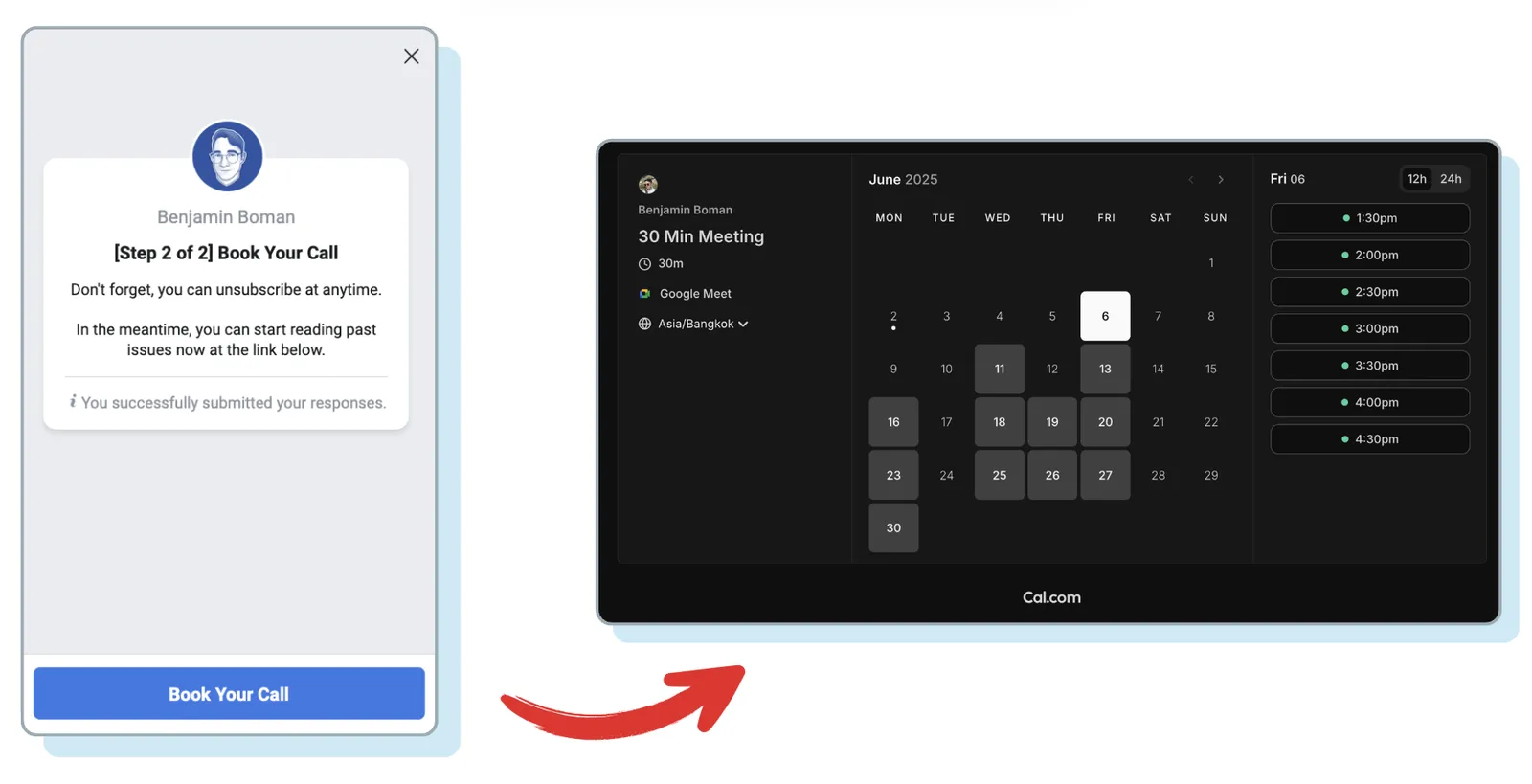
<h3 id="instead-use-a-facebook-lead-form-and-direct-people-to-book-upon-completion">Instead, use a Facebook lead form and direct people to book upon completion:</h3>

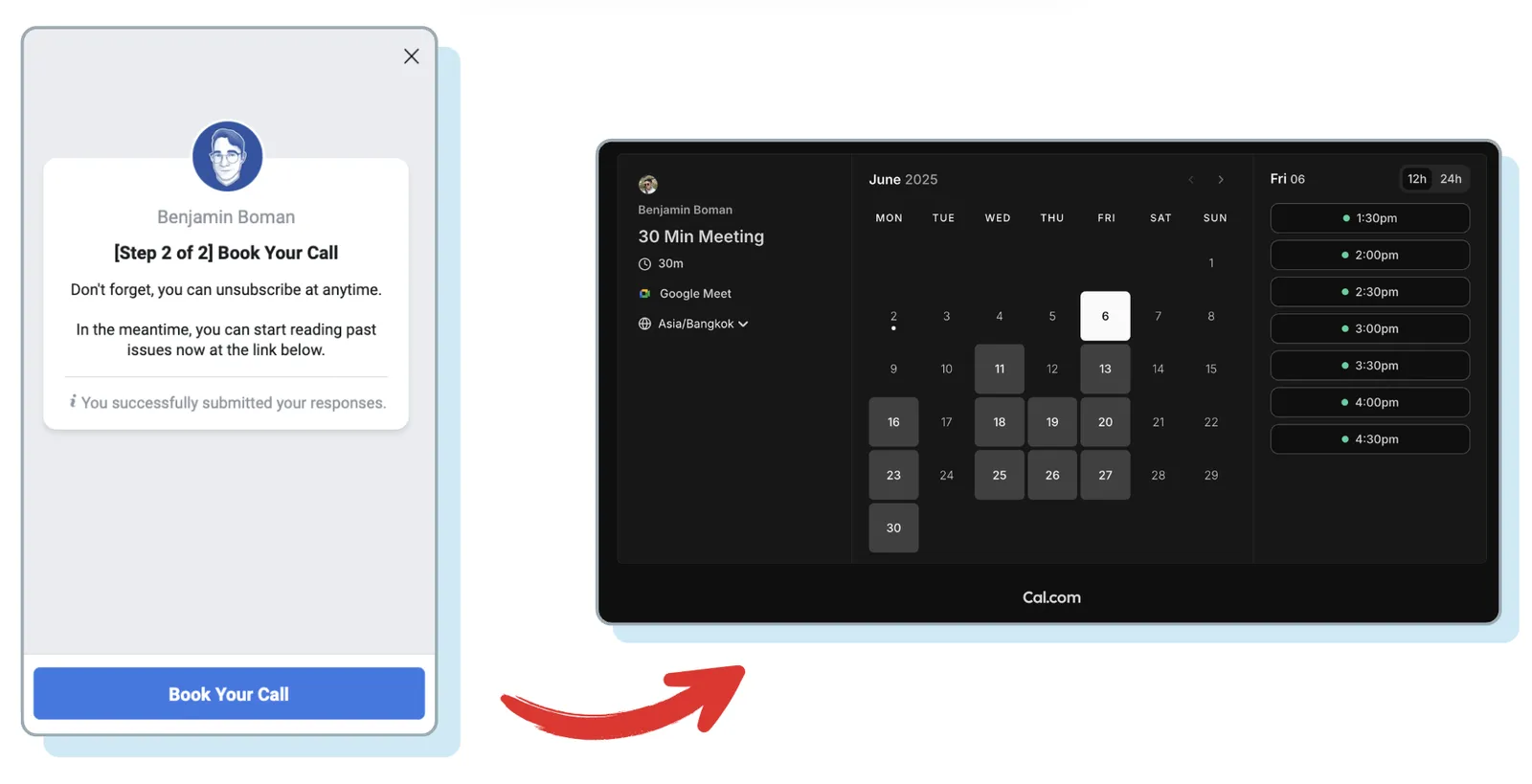
<p><img src="/assets/images/blog/book-sales-calls-with-facebook-ads/01.webp" alt="" /></p>

<p>Because conversions are ON Facebook itself, it is:</p>

<ul>
  <li>Cheaper to get momentum.</li>
  <li>Faster to get momentum.</li>
  <li>Simpler to set up.</li>
</ul>

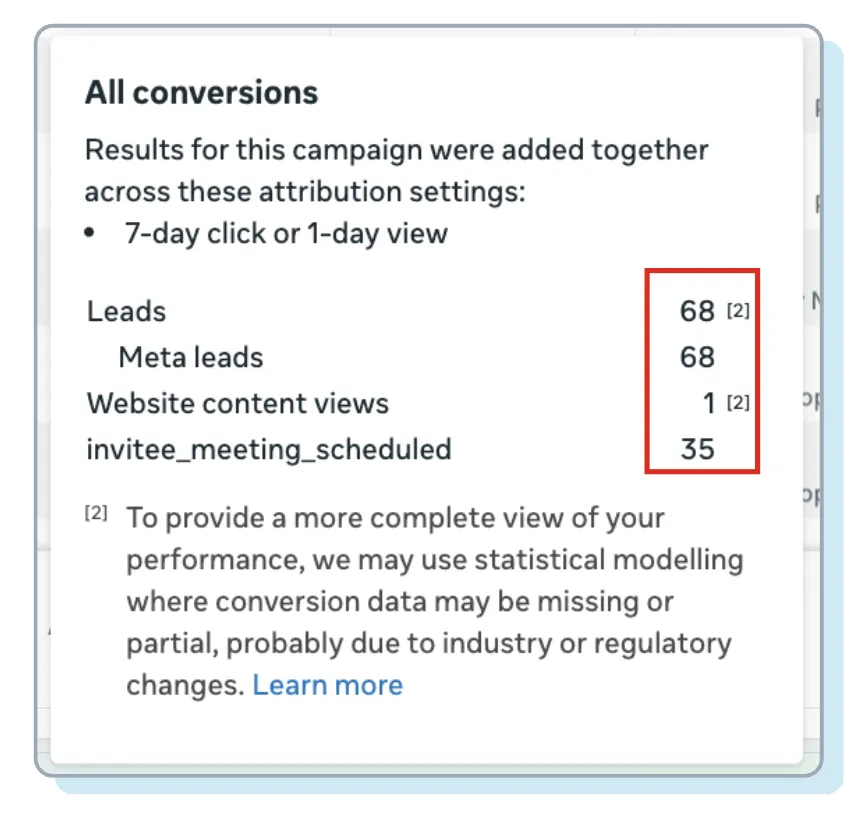
<p>And you can expect around 10 % of leads to self‑book. Sometimes even higher (some campaigns I run get 30-40% self book rates over a month).</p>

<p><img src="/assets/images/blog/book-sales-calls-with-facebook-ads/02.webp" alt="" /></p>

<p>Of course, quality can vary.</p>

<hr />

<h3 id="how-to-set-up-an-instant-form-for-bookings">How to set up an Instant form for bookings</h3>

<p><button type="button" class="video" data-youtube="1REABkVlzY8" aria-label="Play video: Yes, You Can Use Facebook Instant Lead Form Ads to Get Booked Calls">
  <img src="/assets/images/youtube/1REABkVlzY8.webp" alt="" width="1280" height="720" loading="lazy" />
  <span class="video__play"></span>
</button></p>

<ol>
  <li><strong>Set up a campaign</strong> and on the <em>Ad Set</em> level <strong>choose Instant Forms</strong> as the Conversion location.</li>
  <li>At the <em>Ad</em> level, click <strong>Create a new form</strong>.</li>
  <li><strong>Add whatever questions you want</strong> to the form – typically name, email and phone number.</li>
  <li>On the <strong>Message for leads</strong> settings page, change the <em>Headline</em> to something like <strong>“Step 2 of 2: Book your call”</strong> so people know they still need to book.</li>
  <li>Paste your <strong>booking‑page or calendar link</strong> in the <em>Link</em> section and rename the <strong>Call to action</strong> to <strong>“Book your call.”</strong></li>
  <li><strong>Save</strong> your form.</li>
</ol>

<hr />

<h3 id="how-to-improve-bookedlead-quality">How to improve booked‑lead quality</h3>

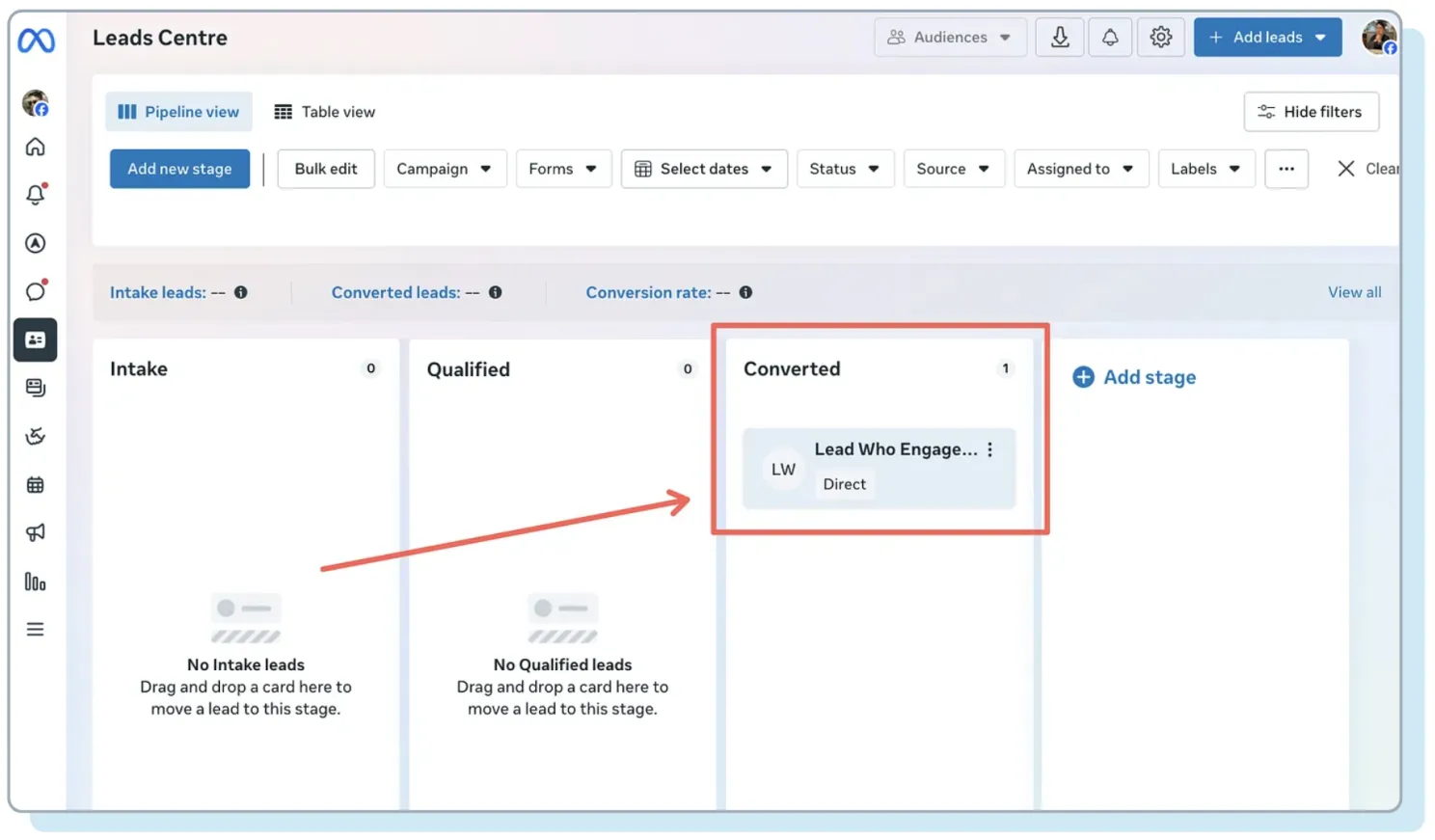
<p>Better yet, you <em>can</em> still optimize the ads for better quality, because anyone who completes the Facebook form automatically lands in the Leads Center.</p>

<p><img src="/assets/images/blog/book-sales-calls-with-facebook-ads/03.webp" alt="" /></p>

<p>In the <a href="https://business.facebook.com/latest/leads_center"><strong>Leads Center</strong></a>:</p>

<ul>
  <li>Click each lead who completed the form.</li>
  <li>Use the Stage dropdown to mark genuine bookings as Qualified and bad bookings as Not qualified (or <em>Lost</em>).</li>
</ul>

<p>This tells Facebook which leads to optimise for, steadily improving quality over time.</p>

<hr />

<p><strong>Want help with Facebook lead gen ads?</strong></p>

<p>Send me a message <a href="https://www.linkedin.com/in/benjaminboman/"><strong>on LinkedIn</strong></a> if you’d like a free 15 minute account audit &amp; strategy session. (Or, just <a href="https://cal.com/benjaminboman/15min"><strong>pick a time here and now</strong></a>)</p>]]></content><author><name>Benjamin Boman</name></author><summary type="html"><![CDATA[Most people are familiar with the vanilla techniques of getting bookings via lead‑generation ads on Meta.]]></summary><media:thumbnail xmlns:media="http://search.yahoo.com/mrss/" url="https://hungrybear.digital/assets/images/youtube/1REABkVlzY8.webp" /><media:content medium="image" url="https://hungrybear.digital/assets/images/youtube/1REABkVlzY8.webp" xmlns:media="http://search.yahoo.com/mrss/" /></entry><entry><title type="html">When Should You Cut Underperforming Facebook (Lead) Ads?</title><link href="https://hungrybear.digital/when-to-turn-off-facebook-ads" rel="alternate" type="text/html" title="When Should You Cut Underperforming Facebook (Lead) Ads?" /><published>2025-09-08T04:43:10+00:00</published><updated>2025-09-08T04:43:10+00:00</updated><id>https://hungrybear.digital/when-to-turn-off-facebook-ads</id><content type="html" xml:base="https://hungrybear.digital/when-to-turn-off-facebook-ads"><![CDATA[<p>This came up with a friend of mine today who is doing his own conversion ads for an indie project.</p>

<p><img src="/assets/images/blog/when-to-turn-off-facebook-ads/01.webp" alt="" /></p>

<p><strong>In other words, when should I turn off low performing ads?</strong></p>

<p>Sadly, there’s no blanket rule that I’ve seen about when to turn things off, but here’s my best shot at giving you a repeatable, logical decision making framework.</p>

<h3 id="1-if-you-are-getting-conversions-and-they-are-trending-down-just-lower-the-budget-20-every-2-3-days">1. If you are getting conversions and they are trending down, just lower the budget 20% every 2-3 days.</h3>

<p>Most Meta media buyers use 20% every 2-3 days as a way to scale up or down a campaign. So I use this to tame campaigns that start to stink. Sometimes it starts to pick up because you were pushing a particular ad or adset too hard.</p>

<p>For example, you have a promotion for a new promotion locally and it’s getting a few conversions a day but once you bump the budget to $100 a day, it struggles. It’s possibly because the market (at that time) doesn’t have enough interest in your area to scale the conversions for that particular creative/messaging combo, for that product, at that much spend per day. So the performance will start to diminish.</p>

<h3 id="2-if-you-dont-have-any-conversions-you-need-to-give-all-ads-3-7-days-of-data-before-making-a-call-before-turning-them-off">2. If you don’t have any conversions, you need to give all ads 3-7 days of data before making a call before turning them off.</h3>

<p>3 days is often minimum I use, and will give you an idea of whether the ad is going to go the right direction in the first few days. E.g. whether you’ll get any conversions with that ad’s combination of creative, messaging, copy, target etc.</p>

<p><em>👉 Note, this is provided that you’re not spending something silly like $2 a day for conversions that would ordinarily cost $70.</em></p>

<p>So to that end, make sure you at least spend 2-3x the projected cost per conversion within those 3 days. The rationale is that if the ad was going to work, you’d probably see it convert within that amount of spend.</p>

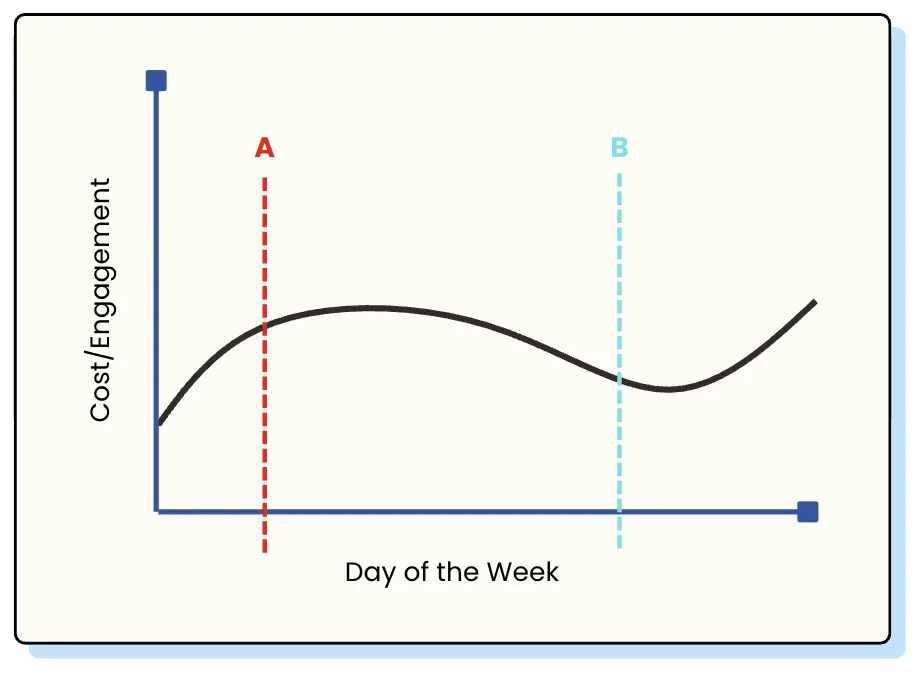
<p><strong>Why 3-7 days? Because this gives Facebook a chance to collect more data over every day of the week.</strong> You’ll know, for example, that weekends perform poorly. So launching on Friday night, and checking the ads on Monday would be ill-advised. Better to launch on Monday and check the next Monday, so you can see how the ad performs across the whole week.</p>

<p><img src="/assets/images/blog/when-to-turn-off-facebook-ads/02.webp" alt="" /></p>

<p>You’ll also be giving Meta a healthier amount of data on time of day. For example, if you launch at 9am in the morning, US Eastern Time, you’ll get more conversions (potentially) in Eastern states, but fewer in Western ones. The ad might over-optimize for Eastern states because of those wins, if the testing window is too short. Versus getting 7 days of data where those differences may be less pronounced than in the short term.</p>

<h3 id="making-a-choice-between-cutting-ads-earlier-rather-than-later-is-a-question-of-how-much-risk-youre-willing-to-take">Making a choice between cutting ads earlier rather than later is a question of how much risk you’re willing to take.</h3>

<p>There are situations where an ad absolutely tanks for 3 days, but suddenly picks up on day 4, and kills it on day 5, 6 and 7. So if you cut ads early, you’re taking a risk that the ad could have come good on day 4+.</p>

<p><img src="/assets/images/blog/when-to-turn-off-facebook-ads/03.webp" alt="" /></p>

<p><strong><em>The way I make the decision is as follows:</em></strong></p>

<ol>
  <li>Are there any conversions yet? If yes, follow 1 above.</li>
  <li>If there are no, how many days has it run?</li>
  <li>Less than 3 days, let it go longer, unless it’s spent more than 3x a reasonable approximate cost per lead/conversion (You can benchmark against your other ads).</li>
  <li>More than 3 days, decide whether I have the budget / risk tolerance to test longer:</li>
  <li>If yes, let it run 7 days then review and cut if necessary.If low/no risk tolerance, cut it early.</li>
</ol>

<h3 id="dont-forget-though-cutting-ads-early-in-some-situations-does-have-the-benefit-of-making-faster-iterations-on-the-big-levers">Don’t forget though, cutting ads early in some situations does have the benefit of making faster iterations on the big levers.</h3>

<p>For example, cutting a simple body copy variation after 3 days makes sense when you have bigger things to test like ad format. That can really change your ad performance, versus testing whether a different testimonial in the body copy makes your ad perform better.</p>

<p>Phew, there you have it. It’s not an easy question but hopefully this has given you an actionable framework to make a decision on when to cut ads or let them ride.</p>

<p><em>If you’re doing ads right now, do you decide in a different way to this? Let me know in the comments.</em></p>

<hr />

<p><strong>Want help with Facebook lead gen ads? Here are 3 ways I can help:</strong></p>

<ol>
  <li><strong>Drop a comment below</strong> if you’ve got a question or want help thinking through your offer - I’m happy to share feedback.</li>
  <li><a href="https://benjaminboman.gumroad.com/l/facebook-lead-ads-accelerator"><strong>Try my DIY course</strong></a>. I made this for my friends who asked for a speedrun on DIY lead ads. It’s how I do what I do, condensed into a digital playbook.</li>
  <li><a href="/"><strong>Get me to run your ads for you</strong></a> <strong>.</strong> If you want done-for-you help, that’s what I do, specifically for sales-led and education businesses.</li>
</ol>]]></content><author><name>Benjamin Boman</name></author><summary type="html"><![CDATA[In other words, when should I turn off low performing ads? Sadly, there’s no blanket rule that I’ve seen about when to turn things off, but here’s my best…]]></summary><media:thumbnail xmlns:media="http://search.yahoo.com/mrss/" url="https://hungrybear.digital/assets/images/blog/when-to-turn-off-facebook-ads/01.webp" /><media:content medium="image" url="https://hungrybear.digital/assets/images/blog/when-to-turn-off-facebook-ads/01.webp" xmlns:media="http://search.yahoo.com/mrss/" /></entry><entry><title type="html">Marketers are Sleeping on Facebook Instant Lead Forms</title><link href="https://hungrybear.digital/dont-sleep-facebook-instant-lead-forms" rel="alternate" type="text/html" title="Marketers are Sleeping on Facebook Instant Lead Forms" /><published>2025-08-25T04:39:57+00:00</published><updated>2025-08-25T04:39:57+00:00</updated><id>https://hungrybear.digital/dont-sleep-facebook-instant-lead-forms</id><content type="html" xml:base="https://hungrybear.digital/dont-sleep-facebook-instant-lead-forms"><![CDATA[<p>Most people tend to think of Facebook lead generation or conversion campaigns as being almost entirely reliant on landing pages built on something like Clickfunnels.</p>

<p><strong><em>But that’s not the full picture. There are plenty of cases where on-platform lead forms can actually be more effective than landing pages.</em></strong></p>

<p>With the cost per conversion rising across Meta platforms like Facebook and Instagram, lead forms are worth considering. <em>Because the conversion takes place within the platform, it’s often cheaper.</em> Meta can more easily gather data and optimise for conversion actions compared to when you’re using an external landing page.</p>

<p>Plus, you can leverage Facebook’s prefill functionality to improve form completion rates, since the user’s info is already populated. (Of course, there are some drawbacks in certain contexts - but used properly, it’s a powerful feature).</p>

<p>Here’s some ideas:</p>

<h3 id="1-lead-forms-can-help-you-build-your-list-for-less">1. Lead forms can help you build your list for less</h3>

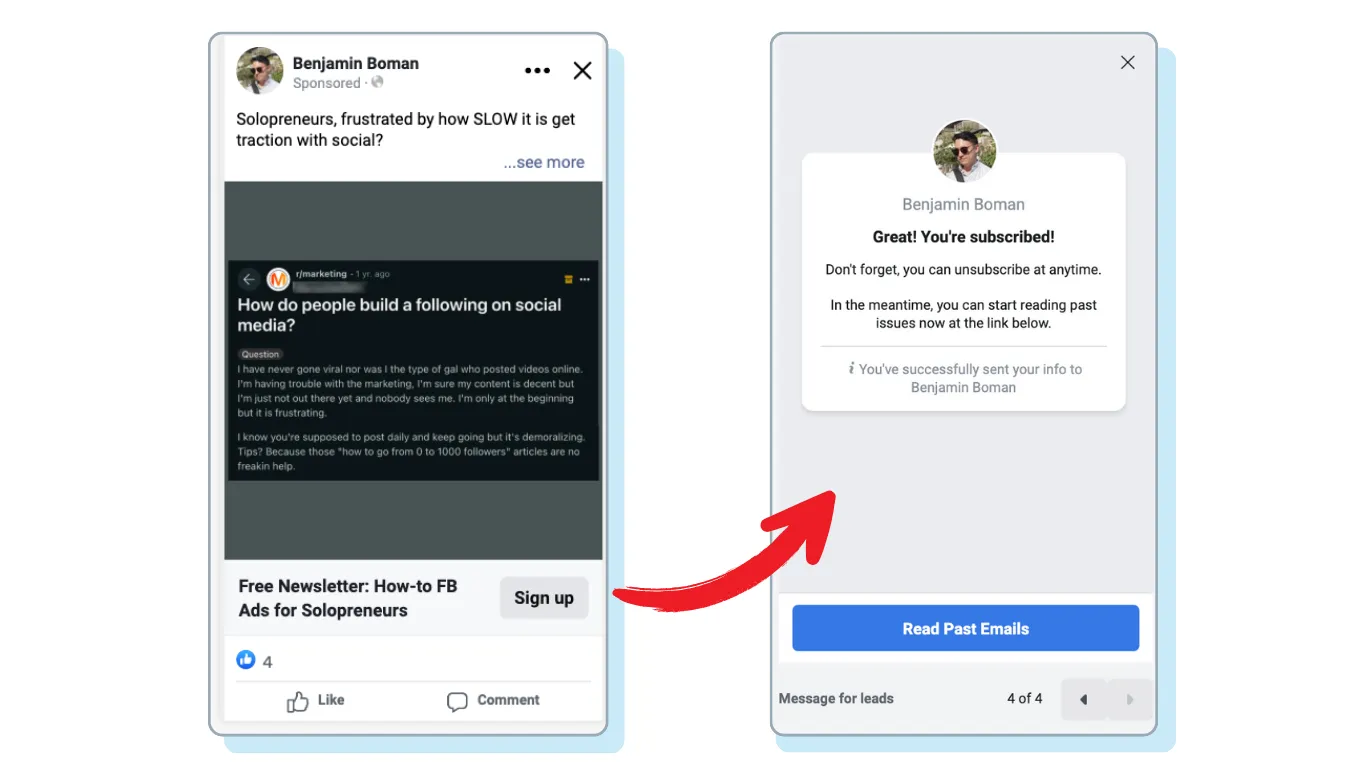
<p>Since the conversion happens inside Facebook, lead forms are often cheaper - which makes them ideal for growing your email list.</p>

<p><img src="/assets/images/blog/dont-sleep-facebook-instant-lead-forms/01.webp" alt="" /></p>

<p>Most creators are used to offering lead magnets via landing pages. But you can get a similar outcome with a lead form by setting up the final CTA button to link directly to the lead magnet itself</p>

<p><strong>⚡️ Tip:</strong> <em>You can send users to your profile and encourage them to check their email for the download. That nudge can help prevent your message from ending up in spam and encourages actual engagement.</em></p>

<p><strong>Sometimes, you can get signups for as low as $2 - $3 with lead forms, while a landing page might cost $5 - $7 for the same result.</strong></p>

<p>And, that doesn’t mean the leads are poor quality.</p>

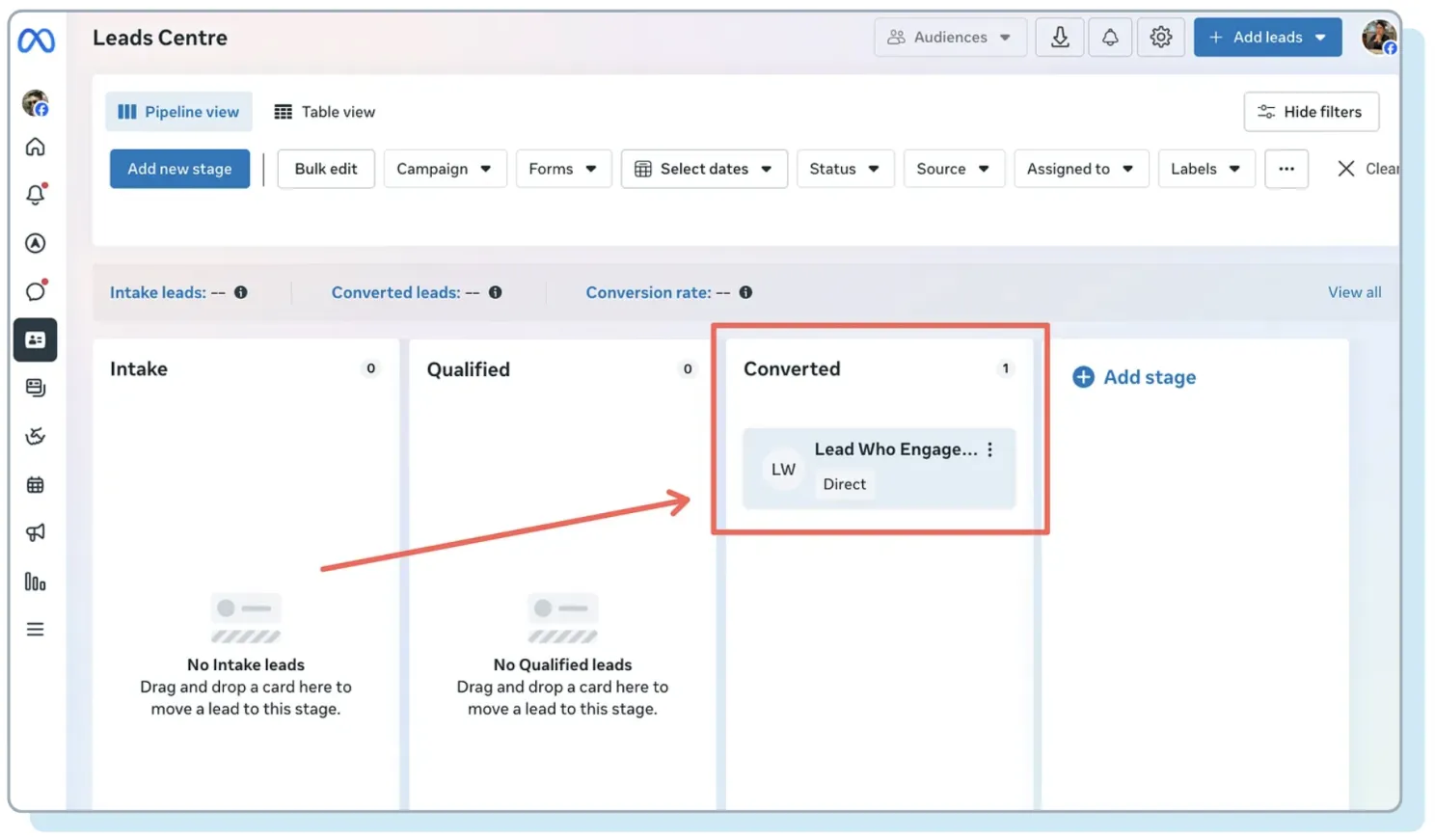
<p>With the Facebook lead centre (their built-in CRM), you can give feedback on lead quality. For example, you can move people who open your emails or click through into the ‘converted’ column. Then adjust your ad set to optimise for converting leads - helping Meta deliver even better signups moving forward.</p>

<p><img src="/assets/images/blog/dont-sleep-facebook-instant-lead-forms/02.webp" alt="" /></p>
<h3 id="2-you-can-layer-in-a-second-objective-like-building-a-facebook-group">2. You can layer in a second objective, like building a Facebook group</h3>

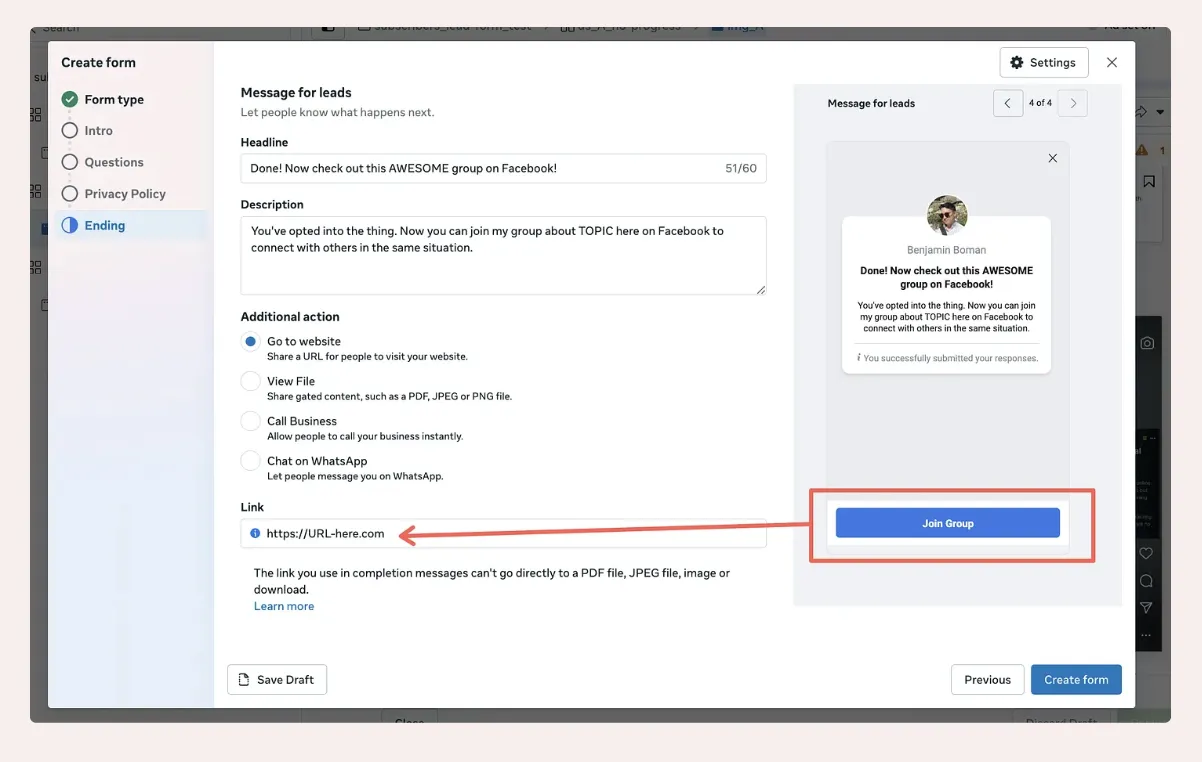
<p>Lower costs open the door to creative stacking of offers. For example, you can run a lead form campaign to get people to opt into a lead magnet - but also encourage them to follow your page or join a Facebook group.</p>

<p><img src="/assets/images/blog/dont-sleep-facebook-instant-lead-forms/03.webp" alt="" /></p>

<p>Using the final CTA button on the form, you can direct users to a specific group.</p>

<p>This gives you a second channel for nurturing people - beyond just email. So if you already have an active community that helps convert browsers into buyers, this becomes a smart, low-friction move.</p>

<h3 id="3-you-can-get-people-to-book-calls-themselves-without-following-up">3. You can get people to book calls themselves, without following up</h3>

<p><strong>A common misconception is that you need a landing page to get booked calls. Not true. You can absolutely drive bookings via Meta’s instant lead forms.</strong></p>

<p>Collect the user’s name, email, phone number through the form.</p>

<p>Then use the final CTA button to send them to your calendar booking page.</p>

<p><img src="/assets/images/blog/dont-sleep-facebook-instant-lead-forms/04.webp" alt="" /></p>

<p><strong>To make this work well, make it super clear on the final screen that there’s one more step - use a headline like “Step 2 of 2: Book Your Call Now”.</strong></p>

<p>Add a short message explaining they need to click the button and choose a time with your team.</p>

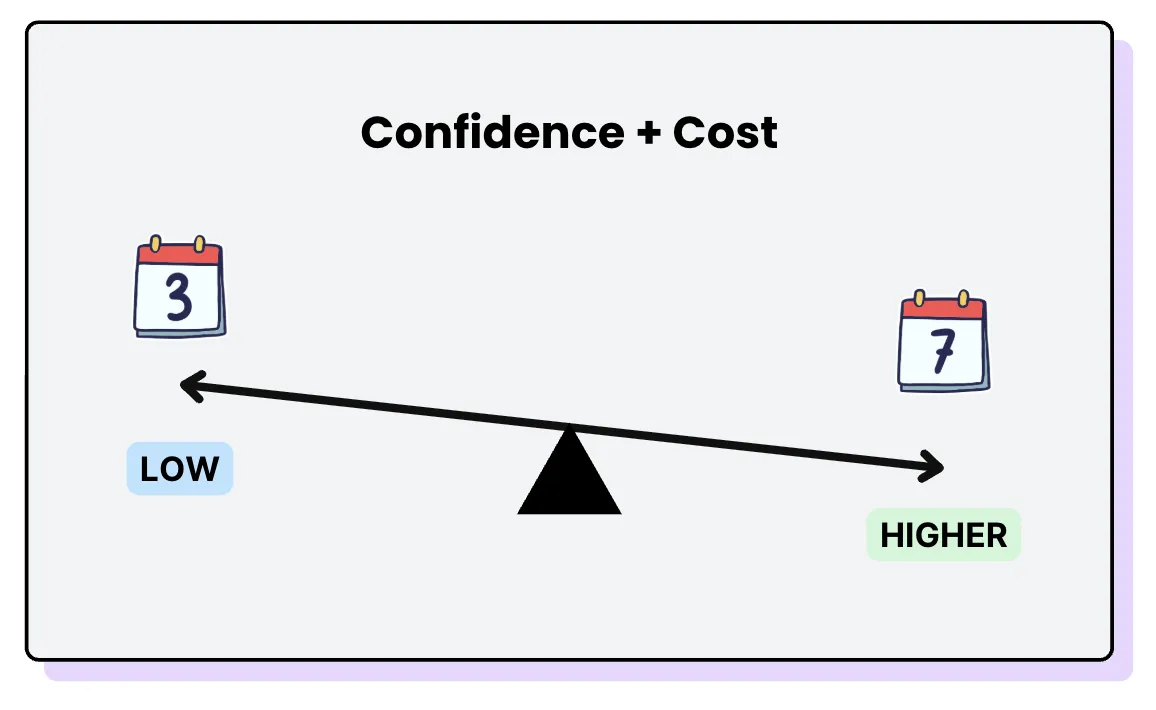
<p>This setup can be particularly helpful if you’re starting from scratch and don’t have reliable data from a landing page. Often, 15 - 20% of people who complete the form will go on to self-book - giving you a lower cost per booked call than traditional funnels.</p>

<blockquote>
  <p>You can use then use lead centre to improve results over time, too by moving only self-bookers to the ‘converted’ column. <strong>Eventually, you can go a step further and filter for qualified applicants who booked - so Meta learns to send you leads that are both interested <em>and</em> the right fit.</strong></p>
</blockquote>

<p>For example, one client I worked with was <strong>getting just a ~16% show rate</strong> for booked calls through lead forms. We started using the lead centre to mark only the people who actually showed up as ‘converted’. After just one week, <strong>the show rate increased to nearly 40%.</strong></p>

<h3 id="how-to-get-started">How to get started</h3>

<p>Consider testing lead forms for different objectives - whether it’s growing your list, booking calls, or building your Facebook group. You might find you can lower your cost per lead <em>and</em> maintain solid quality at the same time.</p>

<p>And there’s no need to go all-in overnight. Just run a small test - maybe $25 or $30 per day. Or even $10 over a longer time frame.</p>

<p>Use the lead centre to track and optimise for the actions you care about - like booked calls, email opens, or group joins. Then compare how it performs over the month against your landing page funnel.</p>

<hr />

<p><strong>Want help with Facebook lead gen ads? Here are 3 ways I can help:</strong></p>

<ol>
  <li><strong>Drop a comment below</strong> if you’ve got a question or want help thinking through your offer - I’m happy to share feedback.</li>
  <li><a href="https://benjaminboman.gumroad.com/l/facebook-lead-ads-accelerator"><strong>Try my DIY course</strong></a>. I made this for my friends who asked for a speedrun on DIY lead ads. It’s how I do what I do, condensed into a digital playbook.</li>
  <li><a href="/"><strong>Get me to run your ads for you</strong></a> <strong>.</strong> If you want done-for-you help, that’s what I do, specifically for sales-led and education businesses.</li>
</ol>]]></content><author><name>Benjamin Boman</name></author><summary type="html"><![CDATA[Most people tend to think of Facebook lead generation or conversion campaigns as being almost entirely reliant on landing pages built on something like…]]></summary><media:thumbnail xmlns:media="http://search.yahoo.com/mrss/" url="https://hungrybear.digital/assets/images/blog/dont-sleep-facebook-instant-lead-forms/01.webp" /><media:content medium="image" url="https://hungrybear.digital/assets/images/blog/dont-sleep-facebook-instant-lead-forms/01.webp" xmlns:media="http://search.yahoo.com/mrss/" /></entry><entry><title type="html">How I Structure Lead Gen Facebook Ad Accounts For Creative Testing &amp;amp; Scaling</title><link href="https://hungrybear.digital/facebook-ad-account-structure" rel="alternate" type="text/html" title="How I Structure Lead Gen Facebook Ad Accounts For Creative Testing &amp;amp; Scaling" /><published>2025-08-19T21:11:27+00:00</published><updated>2025-08-19T21:11:27+00:00</updated><id>https://hungrybear.digital/facebook-ad-account-structure</id><content type="html" xml:base="https://hungrybear.digital/facebook-ad-account-structure"><![CDATA[<p>Got this question from a friend:</p>

<p>“How do I structure testing on Facebook ads?”</p>

<p>A <em>huge</em> question, even if you narrow it down to just lead generation (not eCommerce) campaigns. There’s the technical structure and creative testing process. So let’s tackle the technical structure first and I can write about the creative testing process later.</p>

<p><strong>For the technical structure there are many approaches each with pros and cons. It seems to ultimately come down to your preference on:</strong></p>

<ul>
  <li><strong>creative control</strong></li>
  <li><strong>management simplicity</strong></li>
  <li><strong>spend efficiency</strong></li>
</ul>

<p>While most structures emphasize putting one business/product line per campaign, their particular adset and ad structure varies.</p>

<p>So if you want to nerd out about account structure, here are the 3 main setups I’ve seen and the one I am using below:</p>

<blockquote>
  <p><strong>To skip to my preferred setup, scroll to point 4 below.</strong></p>
</blockquote>

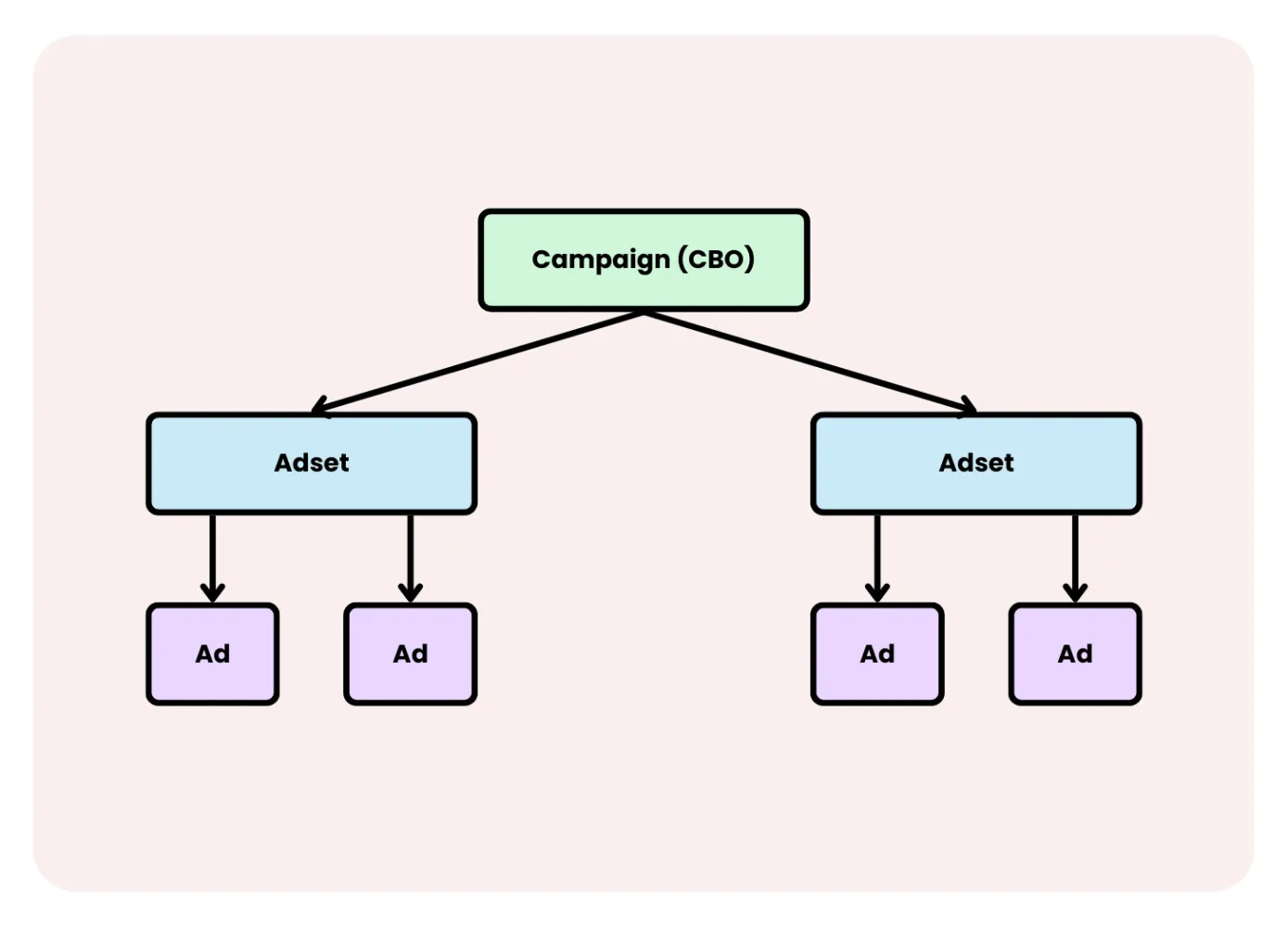
<h3 id="1-plain-vanilla">1. Plain Vanilla</h3>

<p><img src="/assets/images/blog/facebook-ad-account-structure/01.webp" alt="" /></p>

<p>One campaign for each business line with Advantage Campaign Budgeting (CBO). One adset per target audience (typically 1-3 adsets), and 2-5 ads in each adset. To optimize the account, you simply increase/decrease spend 20% every few days, turn off poor performing adsets and ads and replacement.</p>

<p><strong>Pros:</strong></p>

<ul>
  <li>Simple</li>
  <li>Standard</li>
  <li>No overlap on ads or targeting</li>
</ul>

<p><strong>Cons:</strong></p>

<ul>
  <li>Poor control over which target gets more budget</li>
  <li>Poor control over which ad gets more budget</li>
  <li>Meta will naturally prefer videos over static images</li>
  <li>Testing ads means editing adsets (by adding new ads and turning off old ones) so that resets learning.</li>
</ul>

<p>I typically use this approach for very small and simple ad accounts that don’t require much testing.</p>

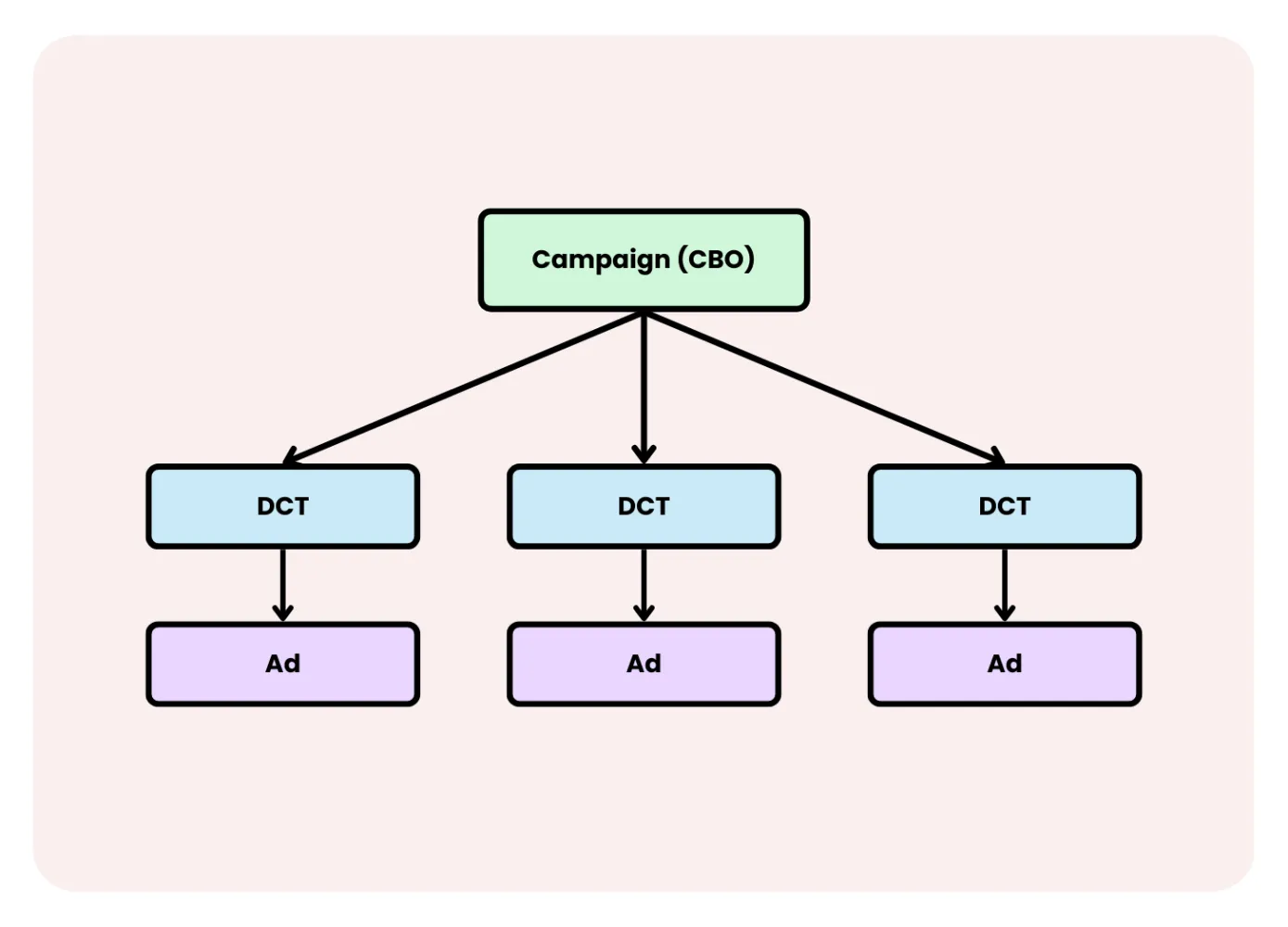
<h3 id="2-automated">2. Automated</h3>

<p><img src="/assets/images/blog/facebook-ad-account-structure/02.webp" alt="" /></p>

<p>Popularized by <a href="https://www.youtube.com/channel/UC3kl2OhNRZ1rH_4bnd0Ap7g"><strong>Charlie T</strong></a>, this setup brings everything into 1 CBO campaign with 2-4 (for example) DCTs. To optimize the account, you increase/decrease spend 20% every few days, launch more DCTs and turn off underperforming ones over time.</p>

<p><strong>Pros:</strong></p>

<ul>
  <li>Nice and simple</li>
  <li>Easy to manage and review performance</li>
</ul>

<p><strong>Cons:</strong></p>

<ul>
  <li>Audience overlap</li>
  <li>Creative overlap if you’re doing message testing. I.e. you’ll need to have two DCTs with the same creatives but different copy</li>
  <li>Reliance on Meta to properly test/discover winners</li>
  <li>Meta is likely to prioritise videos over images</li>
</ul>

<p><strong>This is awesome, <em>if</em> you really trust Meta.</strong> The argument driving this approach is that Meta’s AI knows best and giving it the steering wheel completely is likely the most efficient process.</p>

<p><img src="/assets/images/blog/facebook-ad-account-structure/03.webp" alt="" /></p>

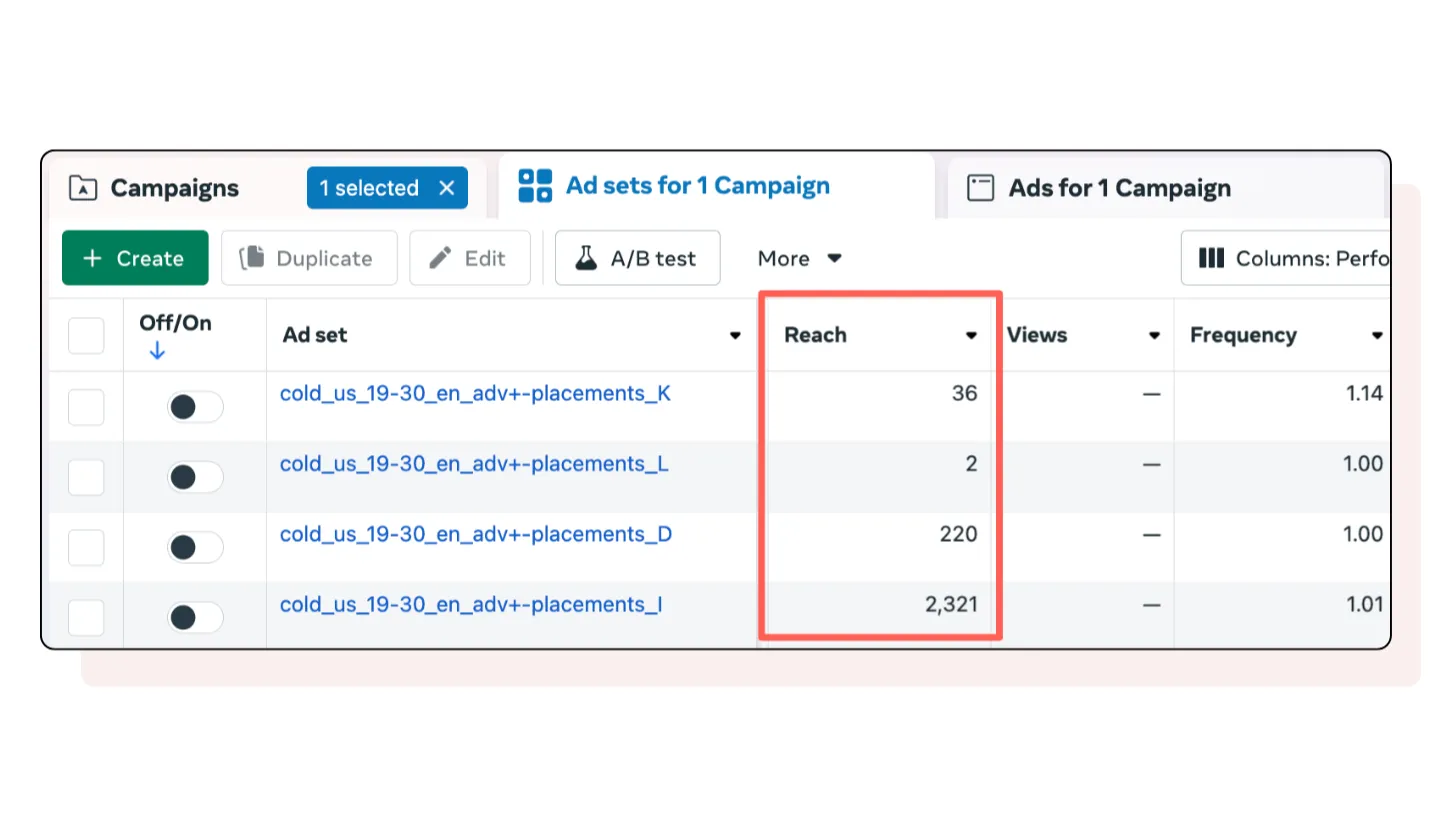
<p>The problem I have with this approach is that you can’t trust Meta to give things a fair go. For example, I’ve launched new adsets to compete in the same CBO campaign, and they’ve received just 2 impressions for around 7+ days. <em>How does Meta know whether those ads are good or not if they’ve not even tried them?</em></p>

<p>I’ve also had instances where an ad was given no attention by Meta via the CBO ad spend, but when given it’s own budget (forcing it by using adset level budgeting) it performs.</p>

<p>Those two experiences don’t gel with this rationale.</p>

<h3 id="3-separated-testing--scaling">3. Separated Testing &amp; Scaling</h3>

<p><img src="/assets/images/blog/facebook-ad-account-structure/04.webp" alt="" /></p>

<p>A blend of the two styles above, except better suited to identifying winners and spending more money on those.</p>

<p>You will have 2 campaigns here.</p>

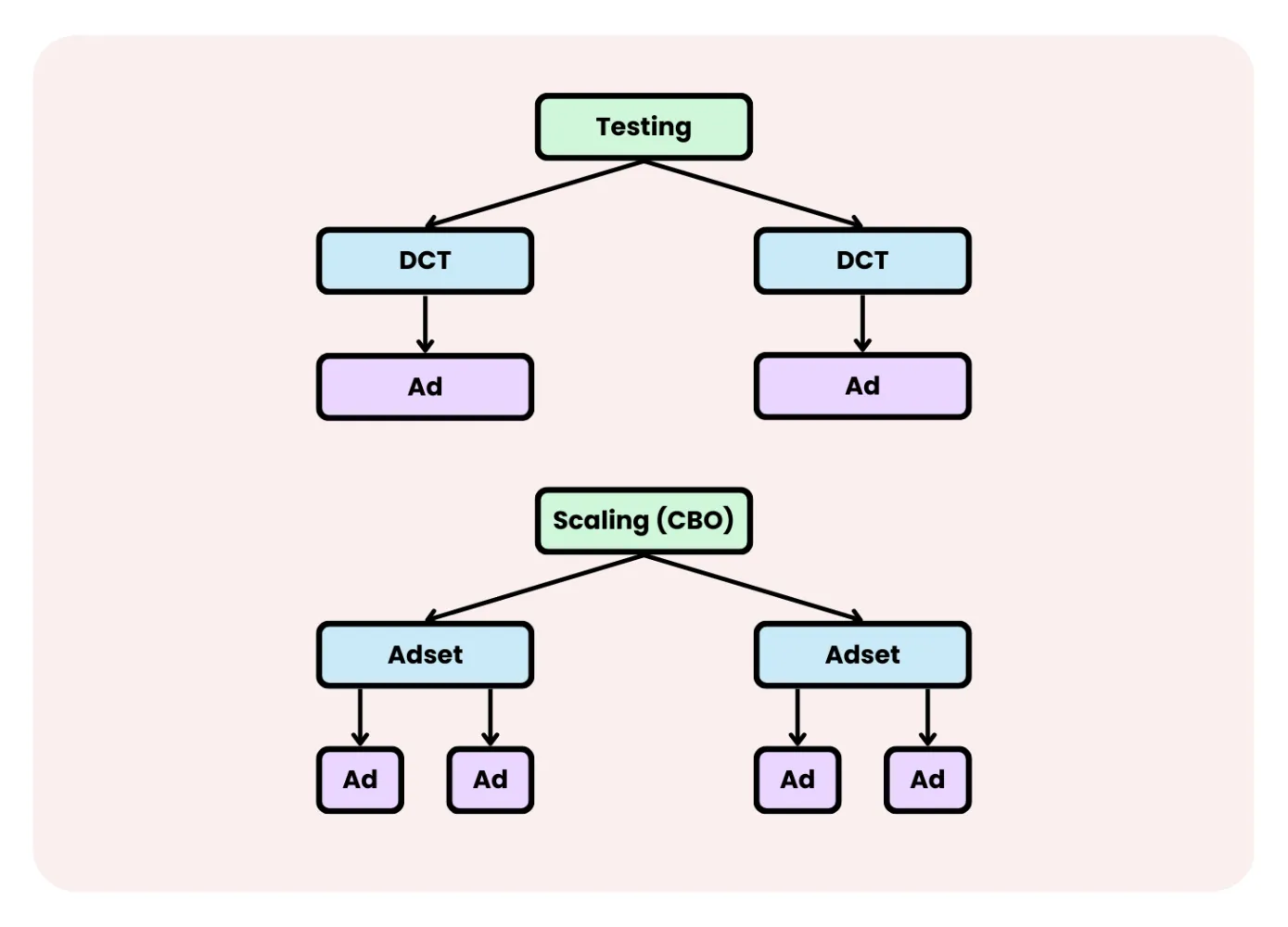
<p><strong>A testing campaign</strong> with adset budget optimization (ABO), with say 10-25% of your budget for testing ads. You’d run Dynamic Creative Tests (DCTs), using the Dynamic Creative option on the adset settings level. Which means 1 ad per adset. I see most advice saying to run 2-4 DCTs at a time.</p>

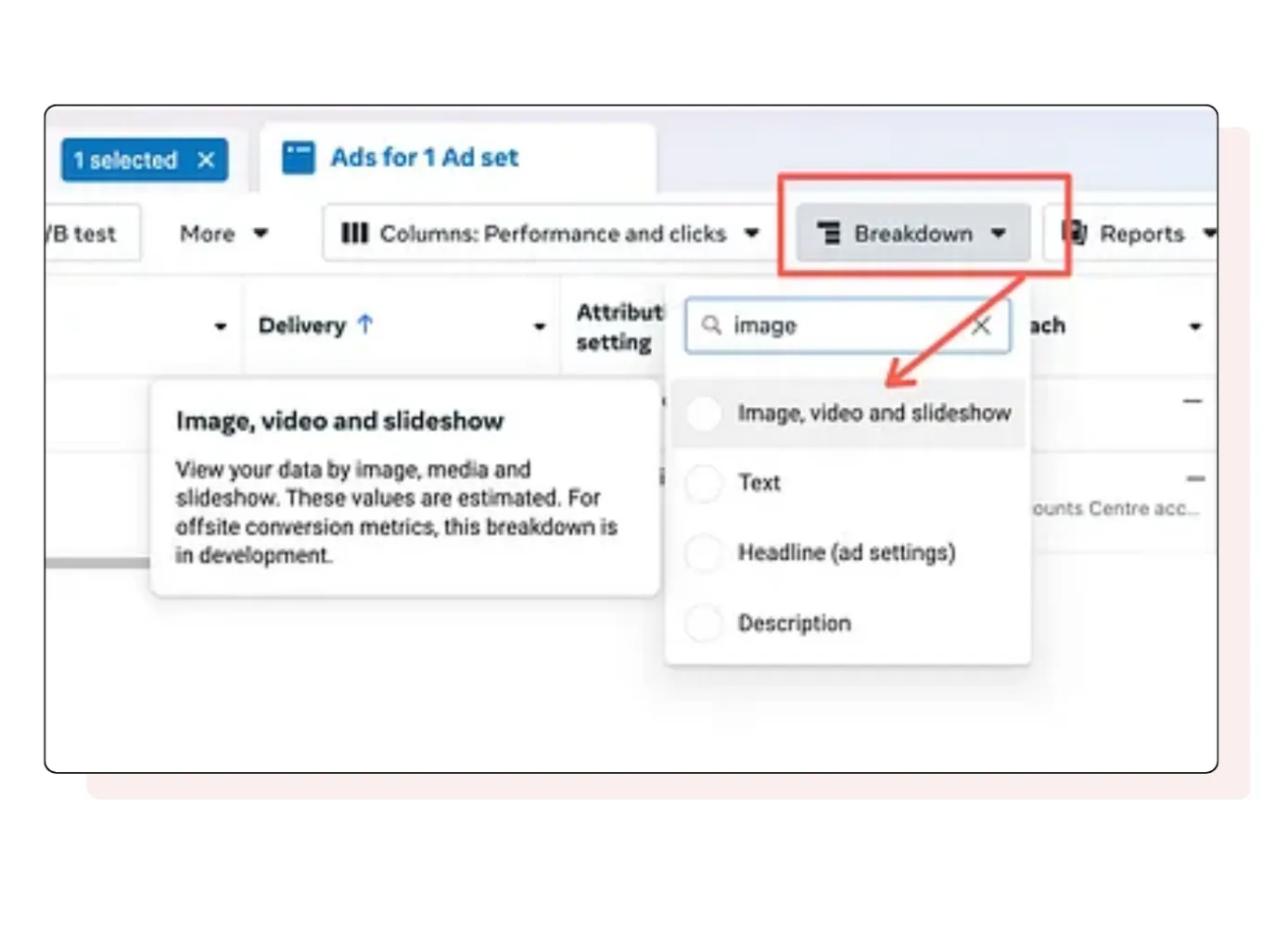
<p><strong>For your scaling campaign,</strong> it has 80-75% of your budget and uses the winning combinations of headlines, copy and creatives from the testing campaign to run them as ads in 1 or more adsets (depending on how many targeting audiences you have). You identify these using the breakdown report.</p>

<p><img src="/assets/images/blog/facebook-ad-account-structure/05.webp" alt="" /></p>

<p>It’s up to you whether you use CBO or ABO. It makes sense to me to use ABO if targeting different audiences.</p>

<p><strong>Pros:</strong></p>

<ul>
  <li>Better control over creative tests</li>
  <li>You can also test different messaging angles by testing the same creatives in one adset vs another, but with different copy</li>
  <li>More efficient adspend on your scaling campaign</li>
</ul>

<p><strong>Cons:</strong></p>

<ul>
  <li>Overlap on campaigns</li>
  <li>Overlap on targeting</li>
  <li>Complex</li>
  <li>Difficult to use for accounts with low spend (because 10% of a small budget doesn’t do anything)</li>
</ul>

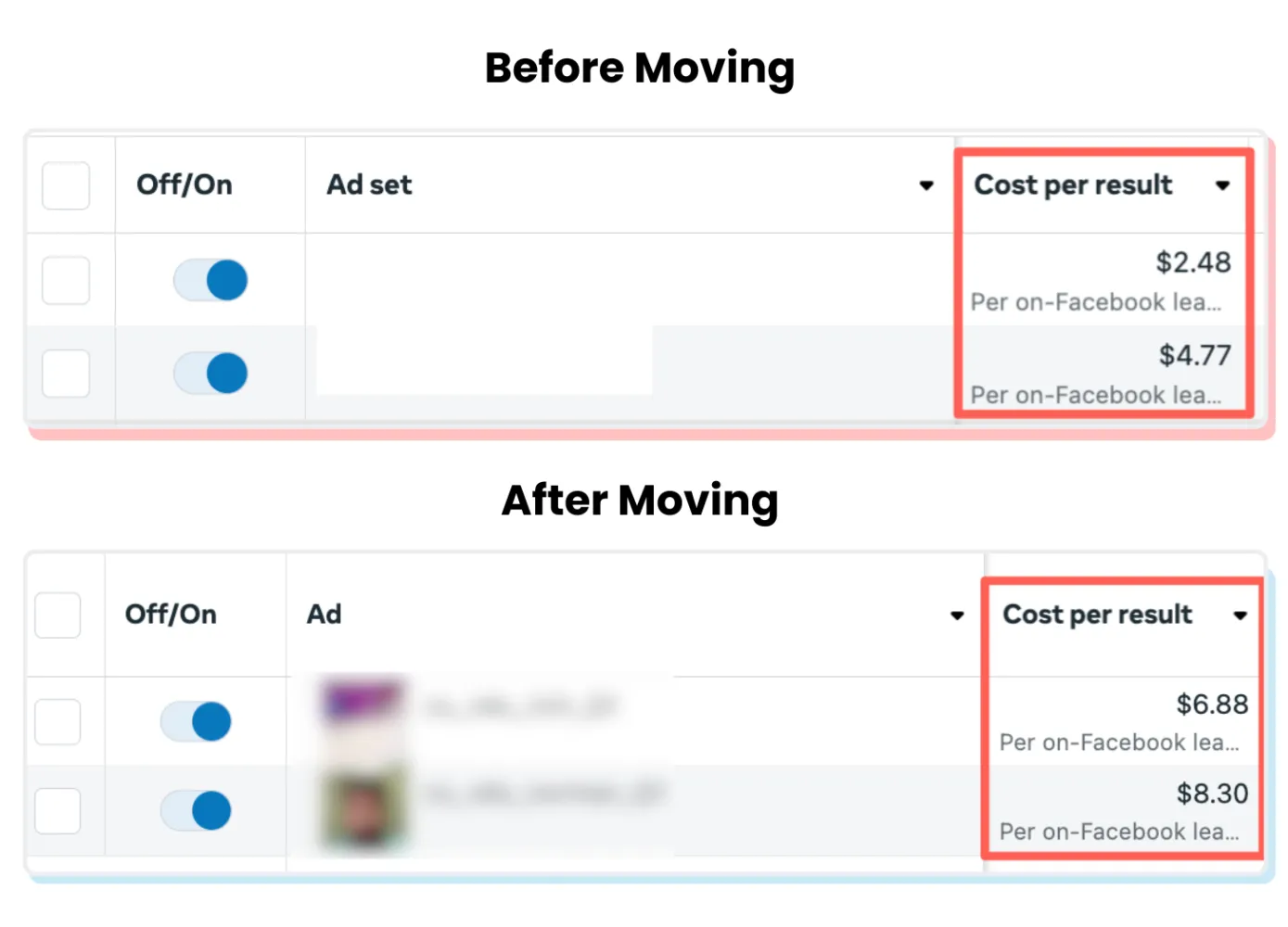
<p><strong>The biggest con about this approach is that ads identified as winners may not scale.</strong> Once you move an ad turn it off and rebuild it somewhere else, everybody knows that the learning resets.</p>

<p><img src="/assets/images/blog/facebook-ad-account-structure/06.webp" alt="" /></p>

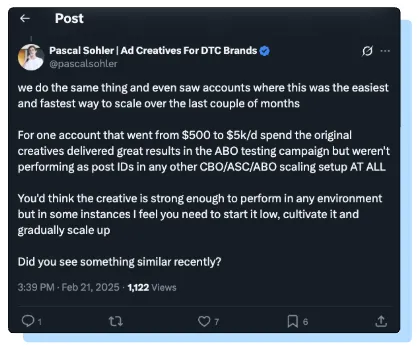
<p><a href="https://x.com/pascalsohler/status/1892856546620584236"><strong>Not just me</strong></a> experiencing this, either:</p>

<p><img src="/assets/images/blog/facebook-ad-account-structure/07.webp" alt="" /></p>

<p>You might get lucky and your $5 cost per lead ad keeps performing that way. Or, once that same ad gets 10x the budget, it suddenly tanks because there wasn’t enough people interested in it anyway.</p>

<hr />

<h3 id="4-is-there-an-ultimate-setup-possibly">4. Is there an ultimate setup? Possibly.</h3>

<p><strong>🔔 UPDATE:</strong> Meta has fully rolled out the Andromeda update, so it’s unclear what the best practice is now. However, these are my notes:</p>

<p>This seems to support the comments made by folks on Reddit to simplify your account structure down to:</p>

<ul>
  <li>1 CBO campaign</li>
  <li>1 broad adset</li>
  <li>15-20+ ads</li>
</ul>

<h2 id="where-to-from-here">Where to from here?</h2>

<p>👉🏼 With this process, I will scale the winning adsets ~20% every 3 or so days, and launch a new challenger adset each week to try beat the cost per lead performance of the winner.</p>

<p>–</p>

<p><em>But this is just my approach. If you’re running ads, let me know your setup structure and your logic for building campaigns that way. I’d love to know!</em></p>

<hr />

<p><strong>Want help with Facebook lead gen ads?</strong></p>

<p>Send me a message <a href="https://www.linkedin.com/in/benjaminboman/"><strong>on LinkedIn</strong></a> if you’d like a free 15 minute account audit &amp; strategy session. (Or, just <a href="https://cal.com/benjaminboman/15min"><strong>pick a time here and now</strong></a>).</p>]]></content><author><name>Benjamin Boman</name></author><summary type="html"><![CDATA[Got this question from a friend: “How do I structure testing on Facebook ads?” A huge question, even if you narrow it down to just lead generation (not…]]></summary><media:thumbnail xmlns:media="http://search.yahoo.com/mrss/" url="https://hungrybear.digital/assets/images/blog/facebook-ad-account-structure/01.webp" /><media:content medium="image" url="https://hungrybear.digital/assets/images/blog/facebook-ad-account-structure/01.webp" xmlns:media="http://search.yahoo.com/mrss/" /></entry></feed>