
How to make a Facebook lead gen advertising strategy (trade schools, academies, courses)
 Written by Benjamin Boman · · 10 min read
A lot of people throw around the word “strategy” for Facebook ads, but never really define it. This is the seven step framework I use to build one, particularly for training academies, trade schools, courses and programmes:
- Target: who you go after, based on value, competition and alignment
- Offer: what you use to get people to engage
- Positioning: how you present that offer
- Creatives: the image formats and video scripts
- Copy: the frameworks and hooks
- Funnel: the mechanism that captures the lead
- Follow up: what happens after, which makes or breaks the ads
For schools and academies specifically, see also how I run Facebook ads for schools.
Transcript
Ever wonder whether you’re just winging the Facebook ad strategy for your course or programme? A lot of people throw around the word “strategy”, but they never really define it. It’s kind of just made up.
And this makes running the ads 10 times harder, because you might not know whether you’re missing some of the key pieces that make your strategy actually work.
I focus full time on lead gen with Facebook ads, so I spend all day finding and fixing these specific strategy gaps for my clients. Today I’m going to show you the seven step framework I use, so you can build your own solid Facebook ad strategy, particularly if you’re running a training academy, a course or a programme.
1. The target
The first thing you really want to work out is who the target is. For most programmes, you can break it down into multiple groups of people. And if you’ve done this before, you probably know internally that each group responds differently and has a different level of interest in your programme.
Take a gym as an example. They could help all kinds of people: women, men, older people, younger and more athletic people, and so on.
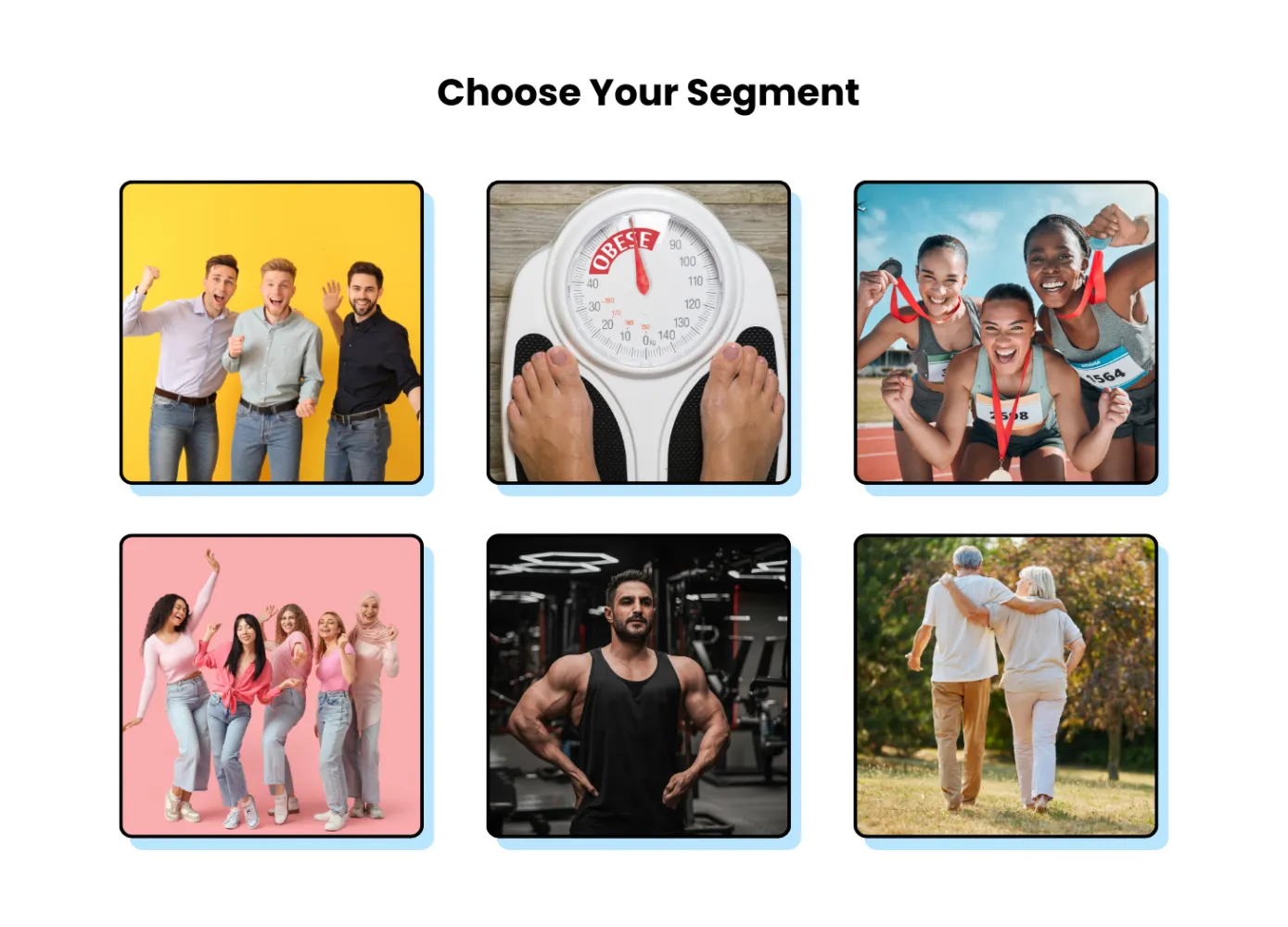
The question to have in mind is: what’s the value, competition and alignment of each of these groups?
- You may find one group is far more valuable than another, but gets less out of the programme
- Another group might be very expensive to target, but gets a lot out of your programme
So you really need to make a decision about who you’re going to target. To begin with, I’d suggest picking a target that has a good mix of being valuable to your organisation (meaning they can actually pay the price) and getting a lot out of your programme, because they’ll be way easier to close.
The X factor to keep in mind is the level of competition. I’d balance value and alignment against how much competition there is for that segment.
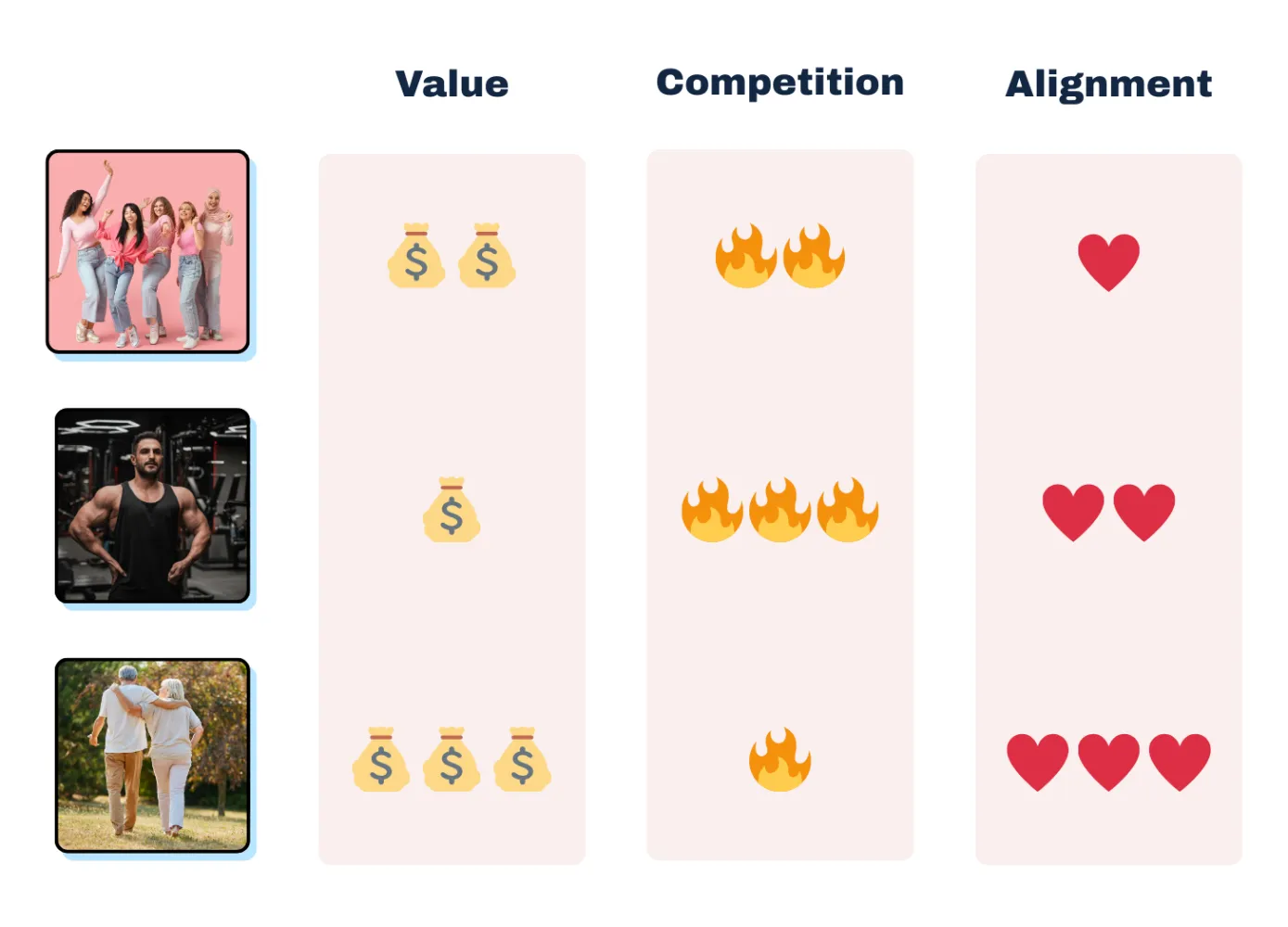
For example, competition for fitter men in the gym space is going to be quite high, but they’ll probably be pretty interested in what you offer. On the other hand, older demographics might actually have a lot more cash than these young men, and the competition is very low, because not many people are talking to them in their advertising.
So that’s the decision: who do you target, based on how valuable they are, how much competition there is, and how aligned they are with your product or service?
2. The offer
Next is your offer. This isn’t necessarily exactly the thing you do. It’s the thing you use to entice people to engage with you, and offers can take a lot of different formats.
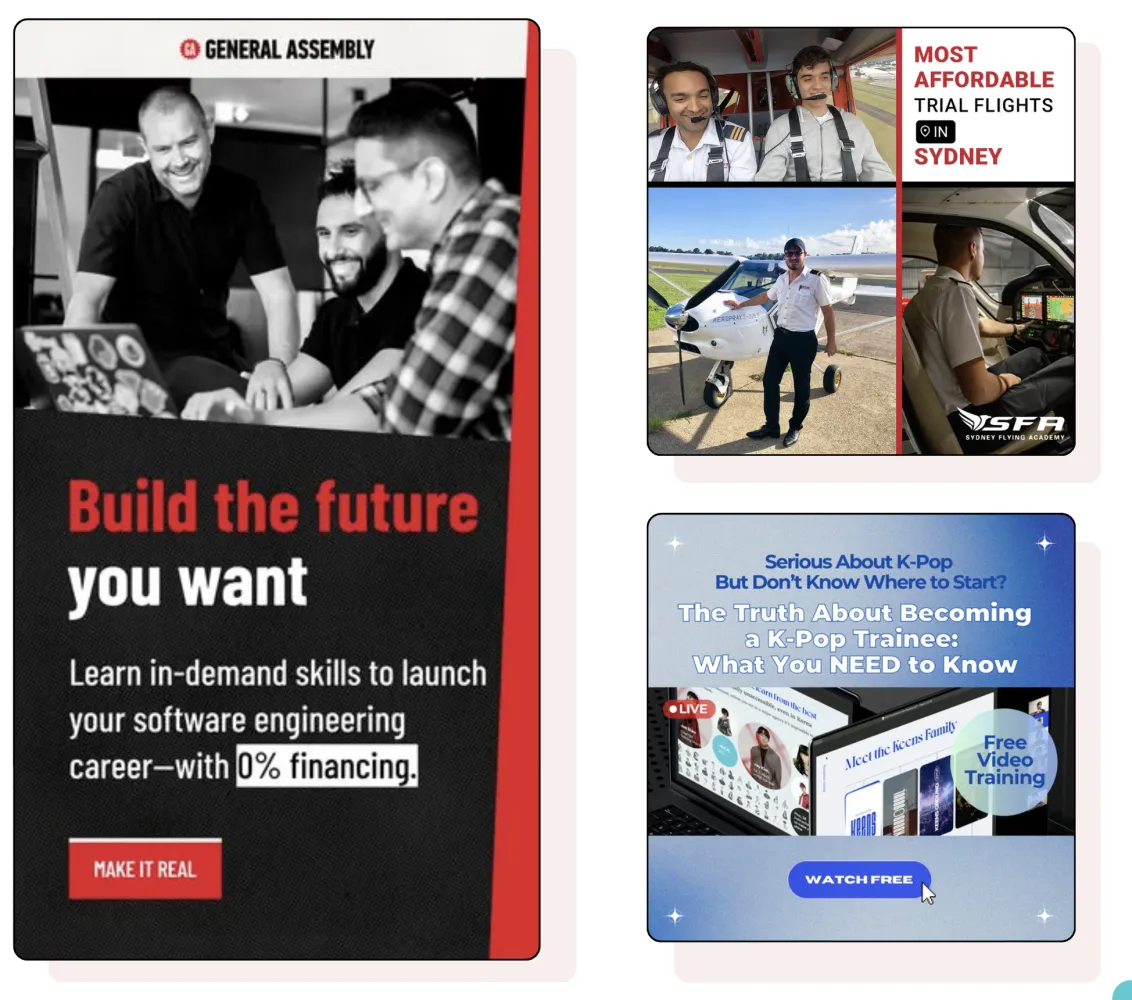
- On the left, General Assembly is basically asking you to request information, and probably book a call directly with them
- Top right, a flight school in Sydney is promoting a trial flight. It’s not just an enquiry into their main programme. They use the trial flight to get people to engage, so they can convert a percentage of the people who take it. On top of that, they’re promoting that it’s a very affordable trial flight
- Bottom right, a K-pop school is promoting a video that trains people on how the industry works, to get more interested people into the funnel so they can convert them to the programme
For trade schools, you’ll probably find most offers come down to:
- In-person tours
- Admission calls
- Video or webinar trainings, direct or indirect (a webinar about your programme, or about a topic related to it, like the K-pop example)
- General content offers, like downloadable resume templates or cheat sheets
- Quizzes and surveys
What I do here is start with the most common offer I see in the market as the baseline. Then I use my clients’ combined judgement and my own to test another offer if needed. That way we don’t accidentally miss a trick, like an offer that gets good quality leads because other people aren’t promoting it.
3. Positioning
Next is positioning, which is how you present that offer. Mark Ritson says there are two ways to position yourself: about something, or against something.
- Against: if your competitors are very expensive, you position against them by saying you’re cheaper
- About: you may find your clients care most about the community of your programme, or its hiring rate. So you position closely around that, like “we have the best hiring rate” or “we have the best community, for X, Y and Z reasons”
Looking back at the flight school, they’re positioning around being affordable, at least for the trial flight.
To work this out, I start with research on what the target market wants and doesn’t want:
- Mining reviews. On Google Maps, for example, a review of a vocal studio in Dubai said it was a great place for young children to develop a love of music and their talent. So that studio might position itself around working with children, or lean into the love of music, compared to competitors. It could also position against competitors who are more geared towards adults
- Comments on videos and social media, like YouTube comments
- The sales team’s deep knowledge. The people who talk with prospective students on the front line know the common phrases people say, like “I was looking for X, Y and Z, and I just hate the idea of doing A, B and C.” Those typical problems and feelings are all good lines to run your positioning on
In practice, I pick two to three messaging angles for testing. You might have a hunch that positioning A will be really effective, but always test at least A and B, and have C lined up. More often than not, the positioning I thought would be really effective turned out to be the loser against B or C.
And you must A/B test this. Otherwise, you might think “ads don’t work” because nobody responded at a profitable rate, when it was actually the positioning they didn’t respond to.
4. Creatives
So you have your target market, your offer and your positioning. Now we can get into the creative.
Creatives have lots of different formats. It’s not just “an ad”. It’s a before and after ad, or a listicle ad, or an item with callouts around it explaining different features of the programme. Memes are another really common format. They all perform differently, so you need to choose a selection.
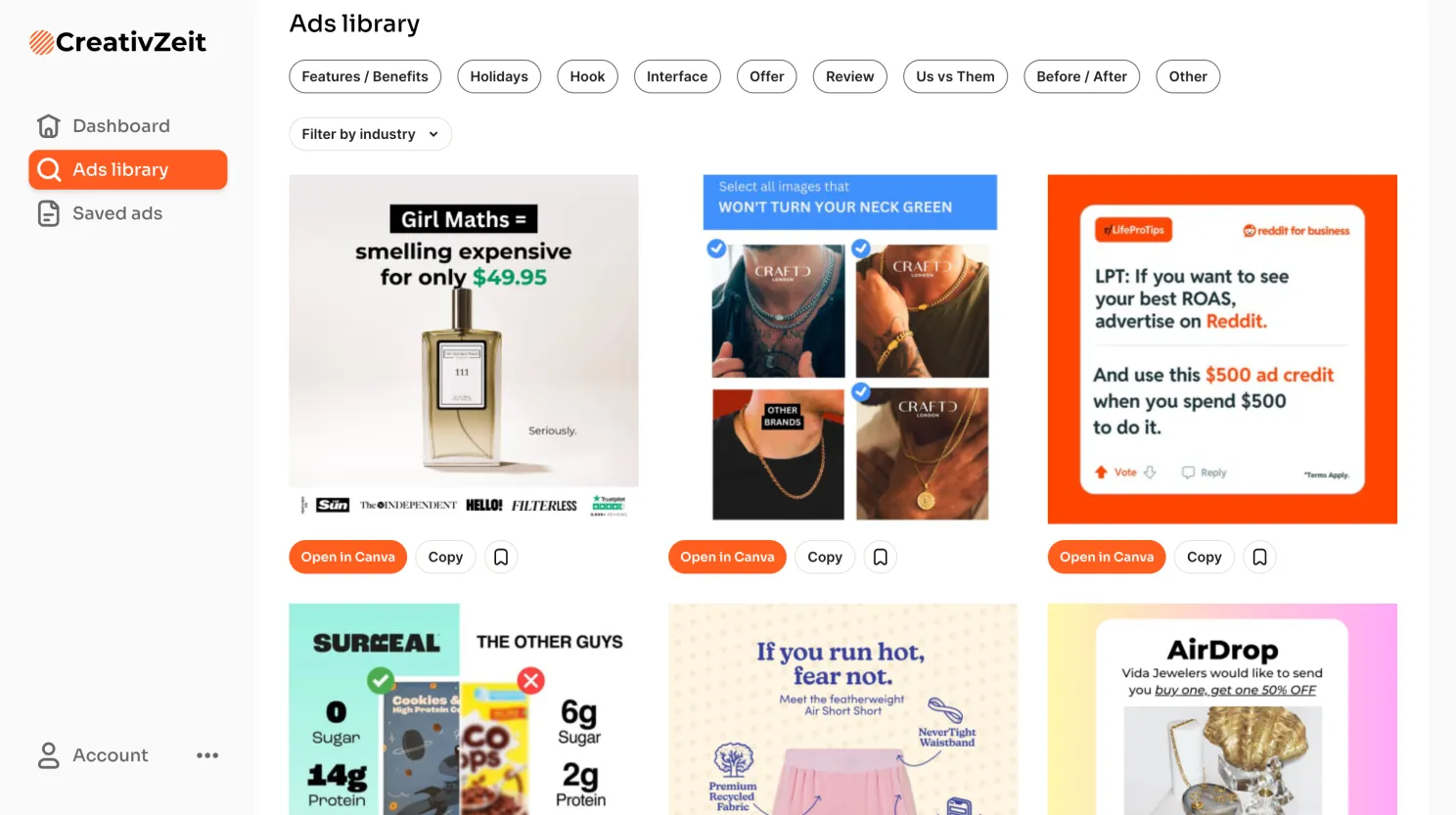
You can choose based on benchmarking what your competitors are doing. But also use your own judgement on what’s worked in the past, and add formats you want to experiment with, so you’re not running the same thing as everybody else. Certain formats tend to perform better than others, and that can come down to a mix of competition, novelty and clarity.
Likewise, for video ads, look at different scripts or script outlines. A very common one in e-commerce is problem, solution. You can also use pain, agitate, solution, testimonials and so on. There are a million frameworks out there. Your competitors give you an idea of the baseline, and your own judgement about how people feel and what they’re looking for guides you beyond it.
To put this into practice, I use about 5 to 10 at a time:
- At a bare minimum, three different formats in one ad set (three script types, or three static image types)
- If you want to expand, five at a time
- Then A/B test them. If you’re testing two messaging angles or two target segments, run an A/B test with at least three to five ads on each, to see which resonates more
Again, you can often be surprised which segment of the market responds better, and which formats get the most traction. (More on how I structure the account for that.)
5. Copy
Like creative formats, copy uses different frameworks and structures. This isn’t the only way to do it, it’s just the way I do it. Formats include:
- Pain, agitate, solution (PAS)
- Attention, interest, desire, action (AIDA)
- Before, after, bridge
You may find one copy format performs way better than another.
Then there are hooks. That’s the first line of your ad copy before someone has to click “see more”, or the headline on the ad itself if it has one. Hooks have different categories. The ones I like, which Liam Casey taught me, are curiosity and transformation hooks. That narrows it down to two categories to test at a time.
Again, pick 5 to 10 to run at a time, so you can A/B test a lot of them at once. (More on how I write the copy.)
6. Funnel
We’re almost there. The funnel is probably the part most people think of with a Facebook ad strategy, but it’s just one piece of the puzzle, the second last one in this case.
The funnel is the mechanism you use to capture leads. It doesn’t always have to be a landing page. It can be:
- Meta instant forms
- Messenger or WhatsApp ads, where people respond by messaging you and going back and forth on those chat apps
- Quiz funnels, where people fill out a survey
- And so on
A lot of people don’t realise you can use Meta instant forms to get bookings. That’s a big hint about some of the mechanisms I see working well for my clients these days.
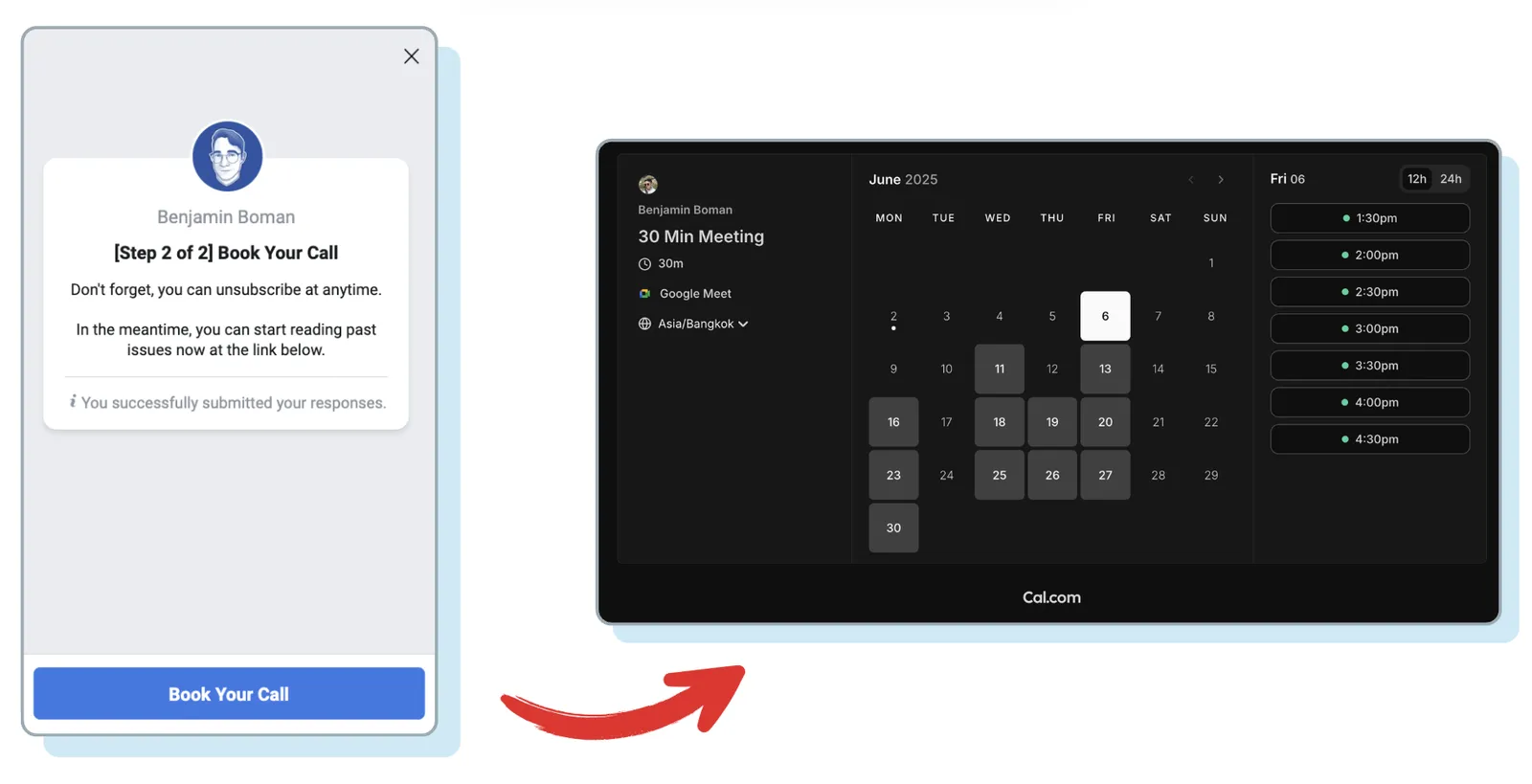
To put this into practice, pick the one most likely to succeed. Use the most common one you see in the market as the A in your A/B test, then pick the B based on your judgement. You can be surprised by the lead volume and quality from two different methods.
A good ads manager will also have the experience to know which setup is best for your industry. For example, Instagram messaging ads might work really well in some countries, but WhatsApp might be the only way people do business in places like Singapore or Kenya.
7. Follow up
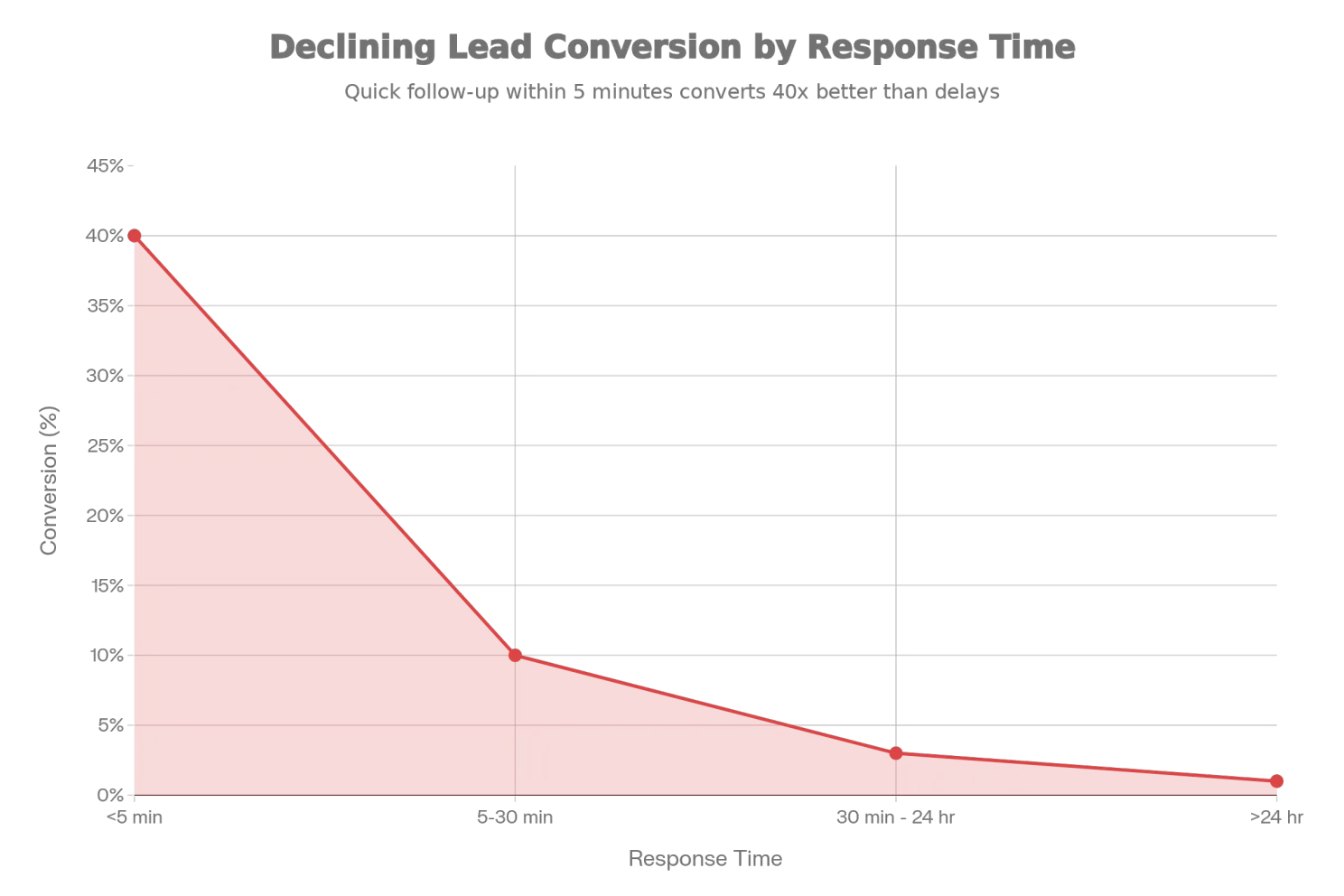
Last up is follow up. It’s not necessarily an ads thing, but it’s absolutely essential to make the ads work. If you can’t do any follow up, you might as well not bother with the ads. It’s that important.
We all know you need to get back to leads quickly. Some quick research on Perplexity suggests you lose around 80% of responsiveness within the first hour, and after 24 hours a lot of the lead’s value is gone. So you really have to jump on those leads quickly.
The typical follow up channels:
- Email automations. The most basic one you need to have in place, at the very minimum
- SMS. Probably the next most basic. There’s some email blindness now compared to 5 or 10 years ago, so use SMS as much as possible
- Phone calls and video messages on top
To put this into practice in 2026:
- Have as many of these in place as possible, within the legal limits where you are
- Adapt your pipeline stages for easy prioritisation. If lead volume is so high that your appointment setting team doesn’t know who to follow up with first, adapt the pipeline so it’s easy for them to prioritise
- Make your call back rate part of the company’s KPIs
And once it’s all running, how to read the numbers it produces.
Putting it together
Once you’ve thought through these seven factors, you’ll have an actual strategy you can use internally to guide and track whether Facebook ads are working as a channel.
- Formalise all seven things and write them down.
- Test your campaign theory, which is the overall setup across all seven, as a whole.
- A/B test certain pieces along the way (which target segment, which mechanism, which angle, which offer) so you aren’t leaving money on the table or shooting yourself in the foot with something that isn’t competitive in the market.
- Repeat the process to come up with new ideas and refine the plan. Naturally, you’ll refine it as you go.
Don’t forget, Facebook and Instagram ads are player versus player. Your competitors are out there trying to beat your ads by being more creative, sharper in their funnels and better at their ad copy. You can’t just put anything in play and hope it works. You actually need to compete in the market.